Spanish scientists halve aphid-spread crop viruses with a harmless decoy particle
Researchers at Spain's Institute of Agricultural Sciences (ICA-CSIC) and the Centre for Plant Biotechnology and Genomics (CBGP) have designed empty, non-infectious virus-like nanoparticles that take up the spot in an aphid's mouthparts where viruses attach. In the lab they cut transmission of two crop viruses by about half, without killing the insects. The method has not yet been tested in the field; CSIC has applied for a European patent.
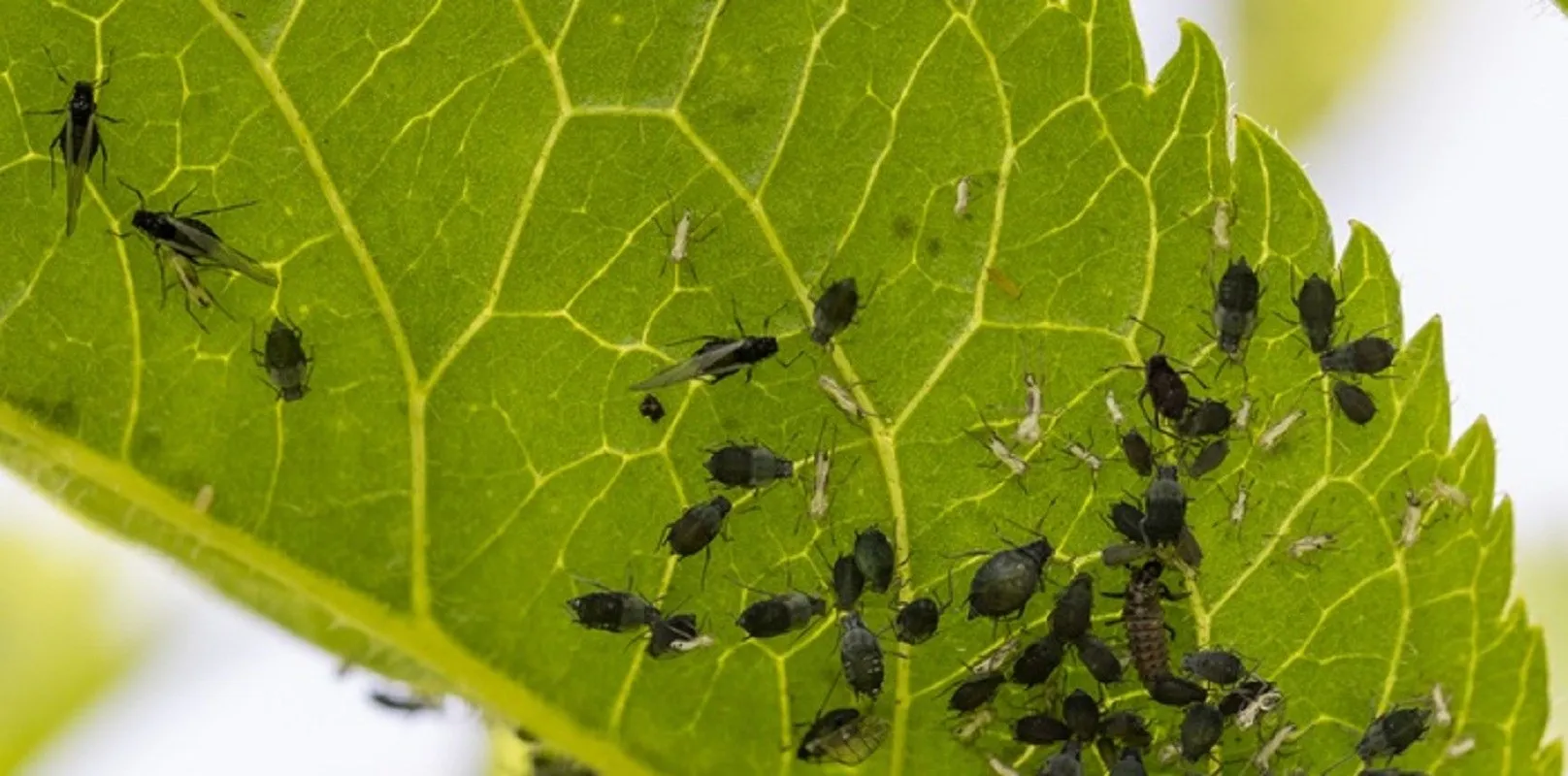
An aphid feeds on a sick plant, picks up the virus on its mouthparts and seconds later drops it into the next one. That is how most crop viruses spread. A team at Spain’s National Research Council (CSIC) has found a way for the insect to reach the healthy plant with its mouth already occupied.
The groups of Alberto Fereres at the Institute of Agricultural Sciences (ICA-CSIC) and Fernando Ponz at the Centre for Plant Biotechnology and Genomics (CBGP, CSIC-UPM) published the work in the journal Annals of Applied Biology. These are laboratory results: the method has not yet been tried in a crop field.
An empty virus that takes the real one’s seat
The researchers built nanoparticles from virus parts but without any genetic material, so they cannot infect anything. The particles stick to the aphid’s stylet, the needle-like mouthpart it uses to pierce plants and suck sap, at the very spot where the real virus attaches.
When aphids took up the nanoparticles first, transmission of turnip mosaic virus and zucchini yellow mosaic virus fell by roughly half, according to CSIC. Transmission of cucumber mosaic virus also dropped. The authors think different viruses use nearby binding sites, so the strategy could work for others of the same kind.
Leaving the insect alive
Most of these viruses are «non-persistent»: aphids pass them on very quickly, so insecticides or natural predators often act too late. CSIC says the approach «does not aim to wipe out aphids, but to stop them acting as carriers», and presents it as an alternative to insecticides.
The nanoparticles could be produced by the plants themselves, engineered to make them, or sprayed onto crops. CSIC has applied for a European patent. The next step is to see whether the effect holds outside the lab.
The work was funded by CSIC, the Madrid regional government and Spain’s Ministry of Science, Innovation and Universities.