Europe picks its next science mission: seven spacecraft to study Earth's magnetic shield
The European Space Agency's member states chose Plasma Observatory on 19 November as ESA's next medium-class science mission (M7). Seven spacecraft will fly in formation to see how energy from the solar wind gets into the magnetosphere, the shield that protects Earth, and help forecast the space weather that affects satellites and power grids. The caveat: launch is planned for the late 2030s, and the mission still has to be designed in detail and built.
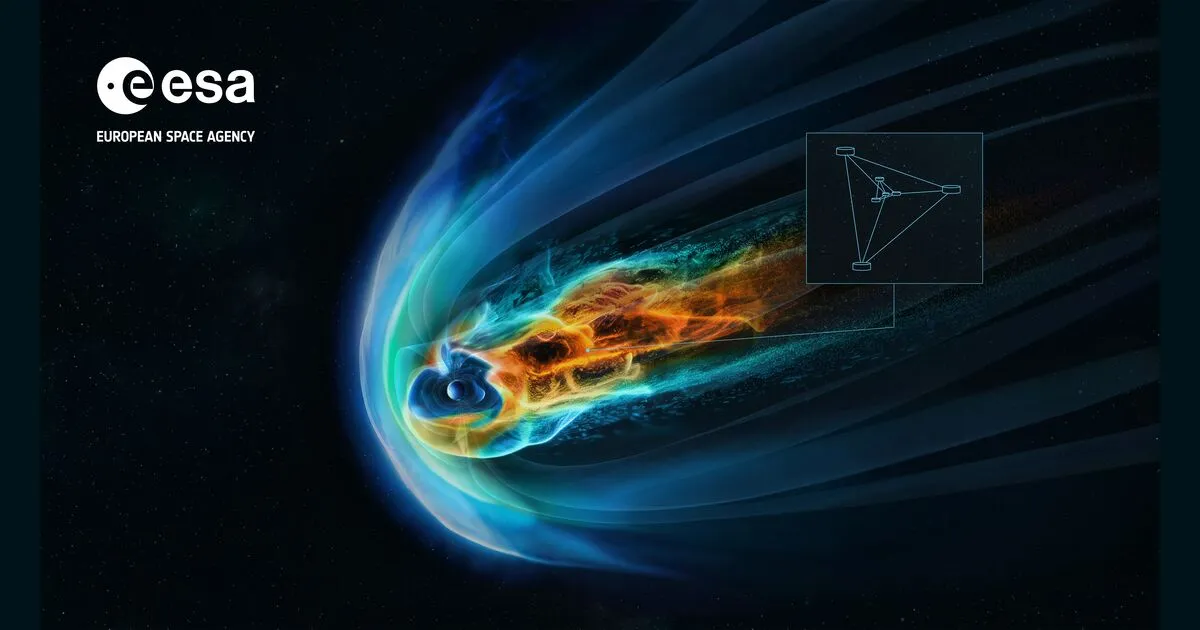
Seven spacecraft flying together around Earth, each measuring the same things at a different point. That is Plasma Observatory, the mission the European Space Agency’s member states chose on 19 November as ESA’s next medium-class science mission, known as M7.
Earth is wrapped in the magnetosphere, a magnetic bubble that deflects most of the solar wind, the stream of charged particles thrown out by the Sun. But some of that energy gets in, and when it does so strongly it causes auroras as well as storms that disrupt satellites, communications and power grids. This is what scientists call space weather.
Seven measuring points at once
A single spacecraft measures what happens at one spot. With seven in formation, according to ESA, the mission can measure fields and particles at seven places simultaneously and see how energy moves through the plasma around Earth, on small and large scales at the same time. It is the next step after Cluster, ESA’s four-spacecraft mission that studied the magnetosphere for more than two decades.
Understanding that process has a very practical use: forecasting solar storms and protecting the technology we rely on.
Chosen from three finalists
Plasma Observatory was competing with two other candidates, M-Matisse and THESEUS. The selection follows several years of studies.
Now the long work begins: defining the mission in detail and building the spacecraft. Launch is planned for the late 2030s.