After 60 years of trying, chemists finally isolate boron-oxygen molecules
A team at the University of Würzburg in Germany, with calculations from Tezpur University in India, has isolated three stable oxoboranes, molecules with a triple bond between boron and oxygen that chemists have pursued since at least the early 1960s. They turned up by surprise, as yellow and orange solids, while two PhD students were testing a different reaction. The work is published in Nature Chemistry. It is basic research with no concrete applications yet.
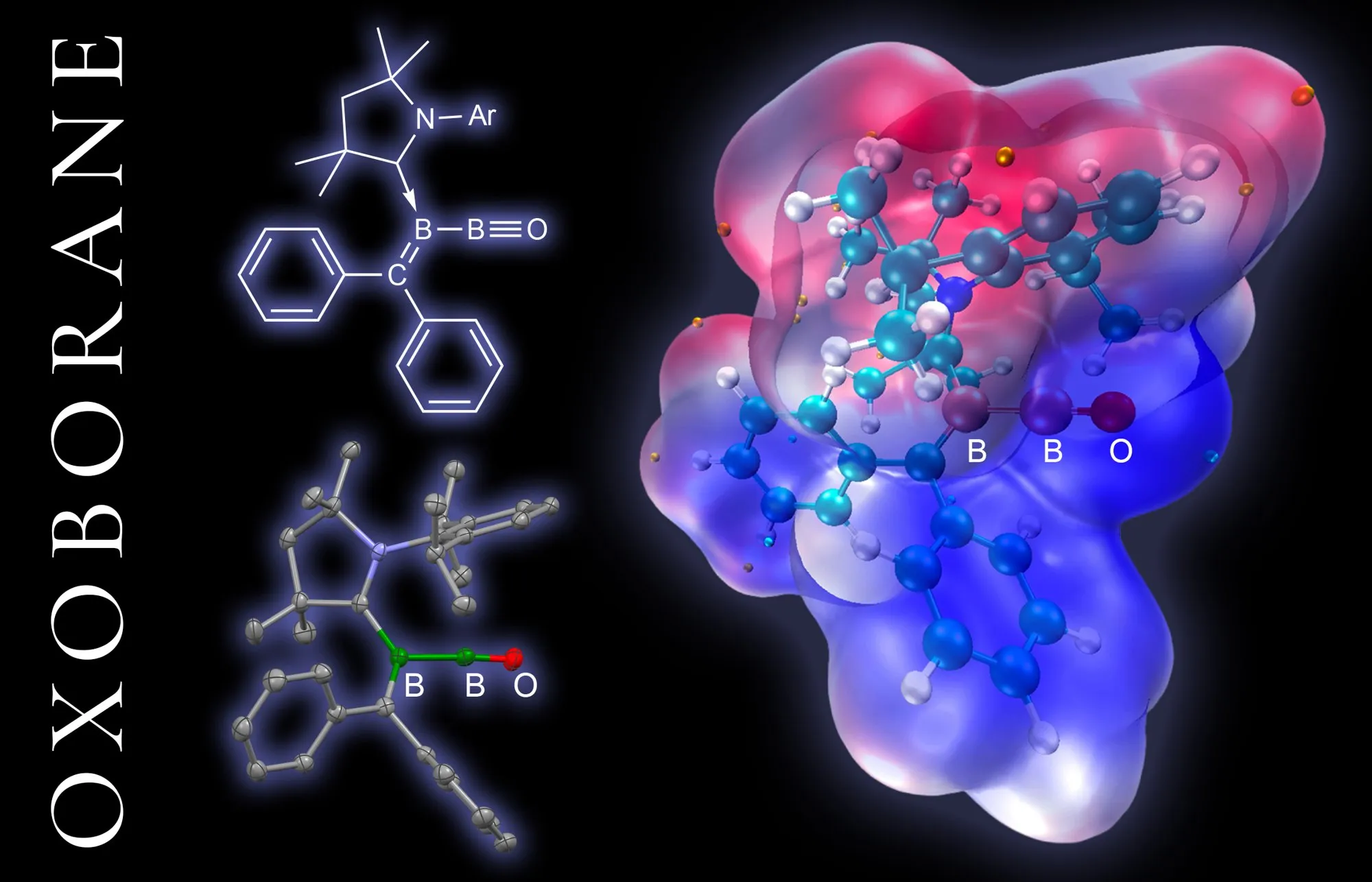
Lukas Lubczyk and Christian Markl, PhD students at the University of Würzburg, were separately testing how a boron compound reacted with different ketones. They expected something else. What appeared were yellow and orange solids: oxoboranes, molecules chemists had been chasing since at least the early 1960s.
A triple bond nobody could hold on to
An oxoborane has a triple bond between a boron atom and an oxygen atom. For decades they were thought too unstable to isolate under ordinary lab conditions. “Nearly everybody in the field had given up on oxoboranes,” says Professor Holger Braunschweig, who leads the group, in the university’s release. The team was “stunned” to see them form and last long enough to study.
They prepared and isolated three different oxoboranes, according to the paper in Nature Chemistry. “The discovery was a pleasant surprise,” says Lubczyk. The calculations that explain their bonding came from Professor Ashwini K. Phukan’s team at Tezpur University in India.
Basic research, no application yet
The work brings no immediate application. The university describes it as a new route for molecular chemistry and possibly a new class of exotic compounds. The group now wants to test whether the same method works with other elements in the periodic table.
It is not the first hard-won bond for this lab: in 2012 it reported the first molecule with a triple bond between two boron atoms, and in 2025 the first neutral molecule with a boron-carbon triple bond. The research is funded by the German Research Foundation (DFG), the German Academic Exchange Service (DAAD) and India’s Department of Science and Technology.