Deer and foxes fit their own GPS collars, so scientists no longer need to catch them
Researchers at the Norwegian University of Life Sciences (NMBU) have tested a system in Norway that lets red deer and red foxes put on a tracking collar while reaching for bait, with nobody catching or sedating them. The work is published in BioScience. These are still prototypes: the method has yet to be proven effective and safe at a larger scale.
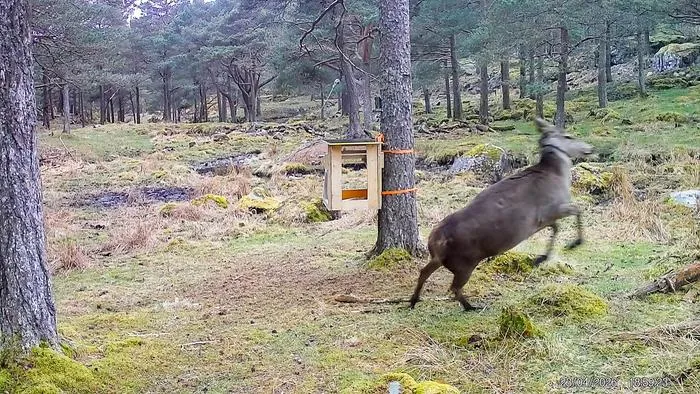
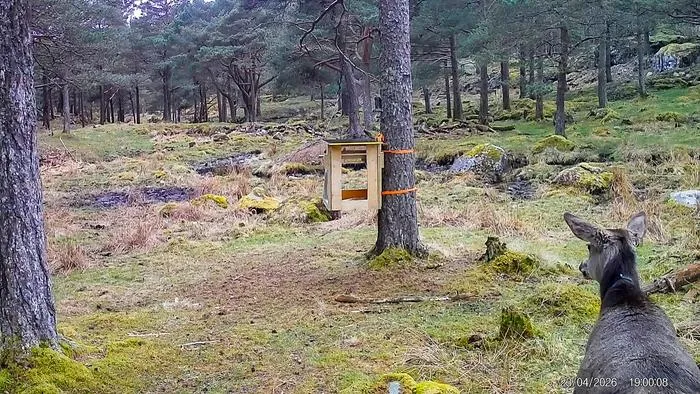
A red deer pushes her head into a wooden box strapped to a pine tree on the Norwegian island of Svanøy, looking for the food inside. When she pulls it out, she is wearing a GPS collar. Nobody has chased her, caught her or put her to sleep.
That is the idea Professor Richard Bischof, of the Norwegian University of Life Sciences (NMBU), sets out in the journal BioScience: Capture-Free Telemetry. For more than sixty years, tracking a wild animal with a collar has meant catching it first. According to the university, that is expensive, stressful for the animal, sometimes injures or kills it, and can put handlers at risk too.
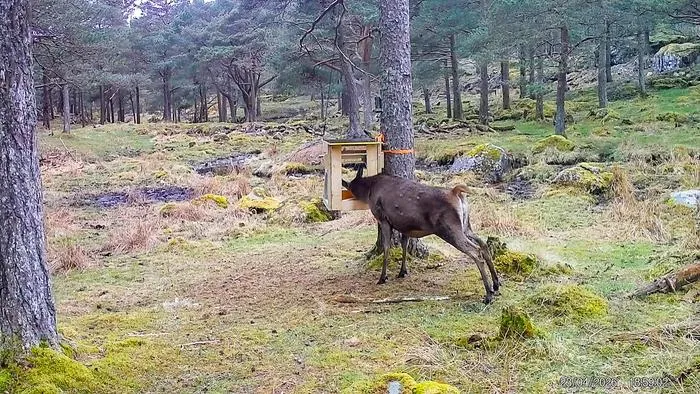 Before collaring: the deer reaches for the bait inside the unit. Photo: R. Bischof / NMBU.
A baited box does the work
The researchers place baited units in the animals’ habitat, designed for each species. When an animal interacts with one, a mechanism slips the collar around its neck. The collars adjust to neck size on their own, drop off after a few weeks or a couple of months, and have weak points so they break away if the animal gets caught or is uncomfortable.
The trials took place in Norway, with red deer at the Norwegian Deer Centre and with red foxes. For Bischof, avoiding capture is not only about welfare: catching and restraining an animal unintentionally changes its behaviour, which is exactly what scientists want to study. A cheaper, gentler method could let researchers follow many more animals for shorter periods, with more detailed data.
 After collaring, on Svanøy. Photo: R. Bischof / NMBU.
An idea borrowed from snares
Before his PhD in Norway, Bischof worked as a biologist for the Nebraska Game and Parks Commission in the US, alongside wildlife capture specialists. The concept is inspired by snares, a controversial tool. Digging into the history, he found that automatic animal marking had already been tried between the 1950s and the 1970s, before being largely forgotten.
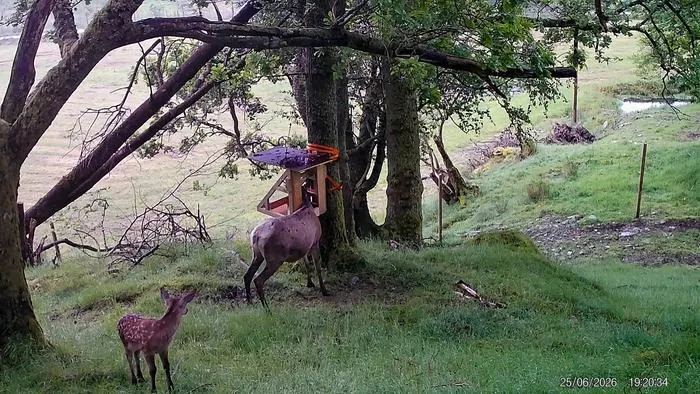 A hind and her fawn next to one of the units on Svanøy. Photo: R. Bischof / NMBU.
What still has to be tested
The prototypes show the system can work, but it is still experimental. Bischof and colleagues in Europe and the US are now comparing its effect on animal behaviour with traditional capture, and looking at how to adapt it to more species. The research was funded by the Research Council of Norway, the Norwegian Environment Ministry and the Astri and Birger Torsted Foundation.
 Professor Richard Bischof, the study’s lead author. Photo: NMBU.