Yeast and electricity turn CO₂ into a building block for biodegradable plastics
Researchers at Germany's UFZ and BOKU University in Vienna have used electricity to turn CO₂ into formate and a yeast to turn that formate into itaconic acid, a raw material for biodegradable plastics, textiles and adhesives, all in a single bioreactor. It is a litre-scale proof of concept: the yield is still lower than when the yeast is fed sugar or methanol.
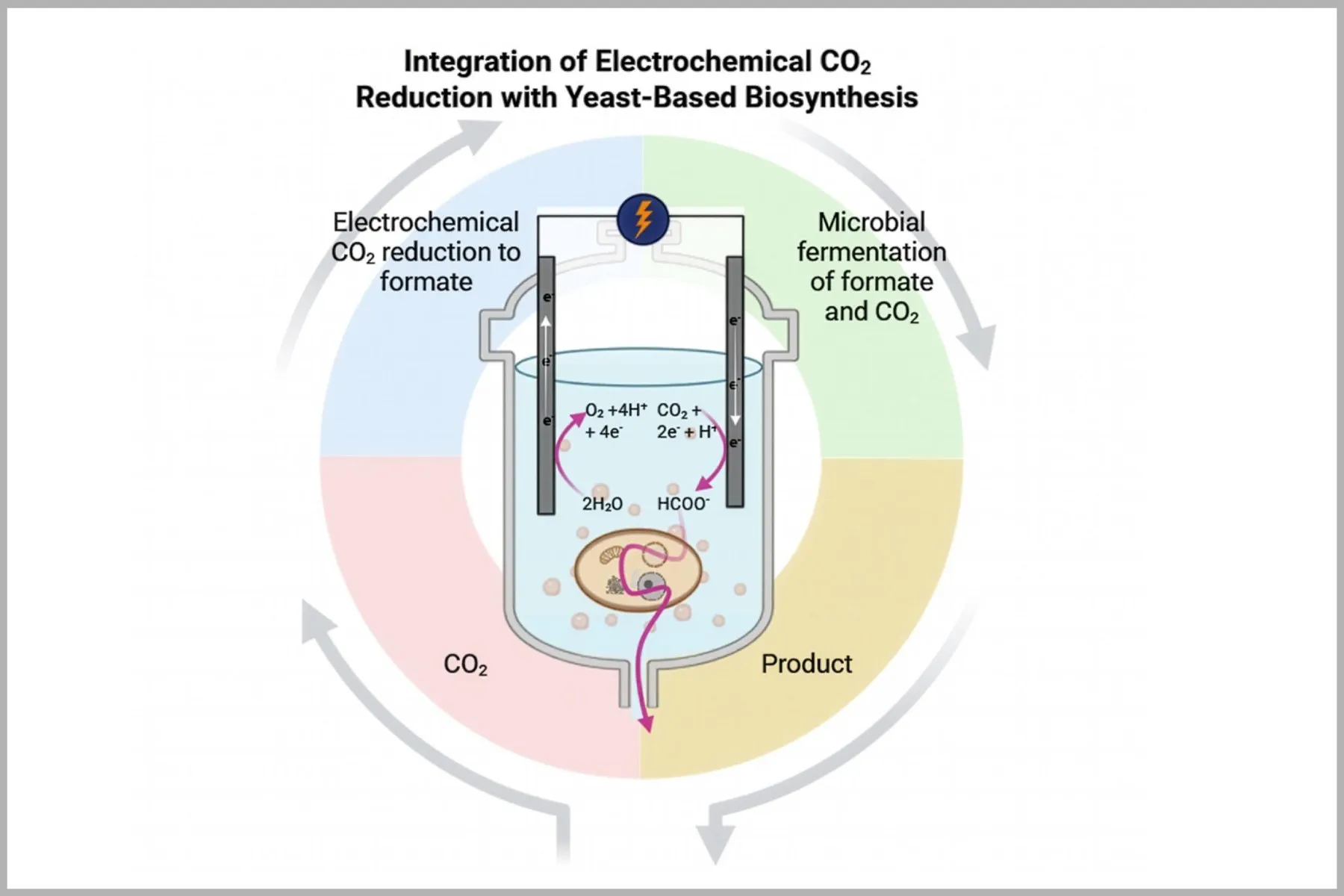
Inside a laboratory bioreactor, two electrodes and a yeast work side by side. The current turns carbon dioxide into formate, a simple salt, and the yeast feeds on it to make itaconic acid, a chemical used to produce biodegradable plastics, textiles, adhesives and resins.
The work comes from researchers at the Helmholtz Centre for Environmental Research (UFZ) in Leipzig and BOKU University in Vienna, and is published in Angewandte Chemie International Edition. The team is clear about the catch: the yield was lower than when the same yeast starts from sugar or methanol. This shows the process works at litre scale; it is not yet an industrial plant.
From sugar to a greenhouse gas
Around 70,000 tonnes of itaconic acid are made worldwide each year, and the figure is rising, according to UFZ. Today it is produced by a fungus fed on sugar. “We have developed a process in which CO₂ can serve as the feedstock instead of sugar, so we can put emissions to good use,” says Falk Harnisch, an electrobiotechnologist at UFZ and the study’s senior author.
The idea built on earlier BOKU research showing that the yeast Komagataella phaffii could make itaconic acid from methanol. Formate is chemically similar to methanol (both have a single carbon atom) and can be made from CO₂ using electricity, ideally from renewable sources. “We wanted to test whether the yeast could also use formate,” says first author Paniz Izadi.
A compromise between two worlds
The hard part was getting both processes to run in one vessel. The electrochemical step works best when hot, alkaline and with few other substances around; the yeast needs about 30°C, a neutral pH and a nutrient-rich medium. “We had to find a compromise to get the best out of both worlds,” says Simone Bachleitner, a senior scientist at BOKU.
Keeping everything in a single reactor means intermediate products do not have to be moved from one place to another, a practical advantage if the process is ever scaled up.
Next, the team plans to optimise the electrobioreactor and test other microorganisms to make more products from CO₂.