Webb spots three giant black holes in a galaxy from the early universe
A team led by the Max Planck Institute for Extraterrestrial Physics has found three active supermassive black holes in the galaxy J0148-4214, seen as it was 1.2 billion years after the Big Bang. The two at its centre are expected to merge within a few hundred million years.
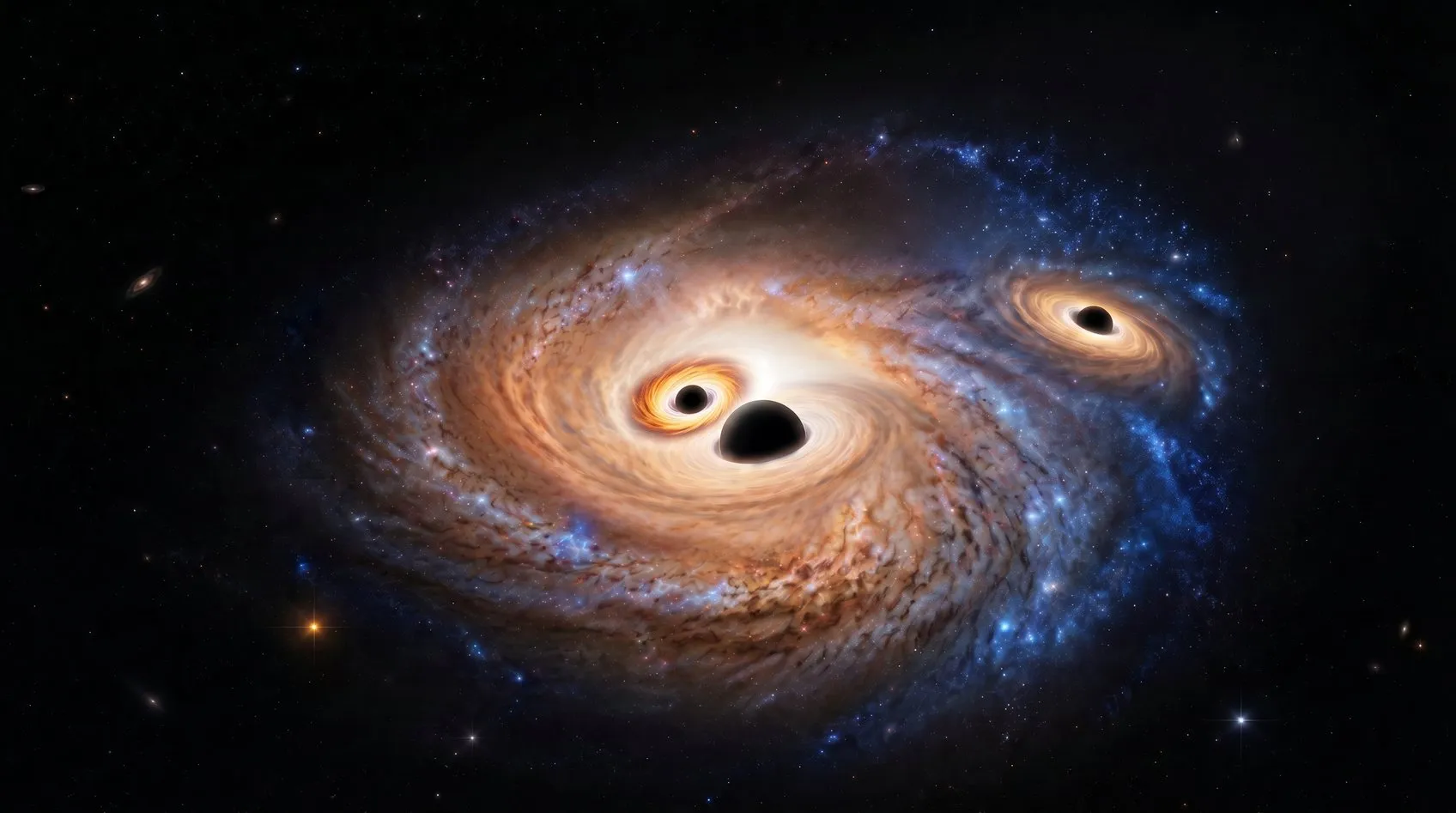
Eighty million suns. That is the mass of the largest of three black holes an international team has found inside a single galaxy, J0148-4214, using the James Webb Space Telescope. Its light has travelled for about 12.5 billion years to reach Earth, so we see it as it was 1.2 billion years after the Big Bang.
“This is the first evidence of three active black holes in a single galaxy in the distant Universe,” says Hannah Übler, research group leader at the Max Planck Institute for Extraterrestrial Physics (MPE) in Germany and lead author of the study, published in Astronomy & Astrophysics. The University of Cambridge is also part of the team. The telescope cannot see the two central black holes as separate points: the researchers told them apart by measuring very precisely where the surrounding gas emits light.
Two at the centre, one on the outskirts
All three are feeding, with gas spiralling into them through a disk. Their masses are roughly 80 million, 600,000 and 2 million times that of the Sun. The two at the centre are 620 light years apart in projection and are expected to merge within the next few hundred million years. The third sits about 5,500 light years from the centre.
The smallest, at 600,000 suns, is growing fastest: it is taking in matter above the limit set by basic theories of black hole growth. The galaxy’s stars add up to about 1.3 billion suns, and the black holes are a significant fraction of that, says Giovanni Mazzolari, the study’s second author.
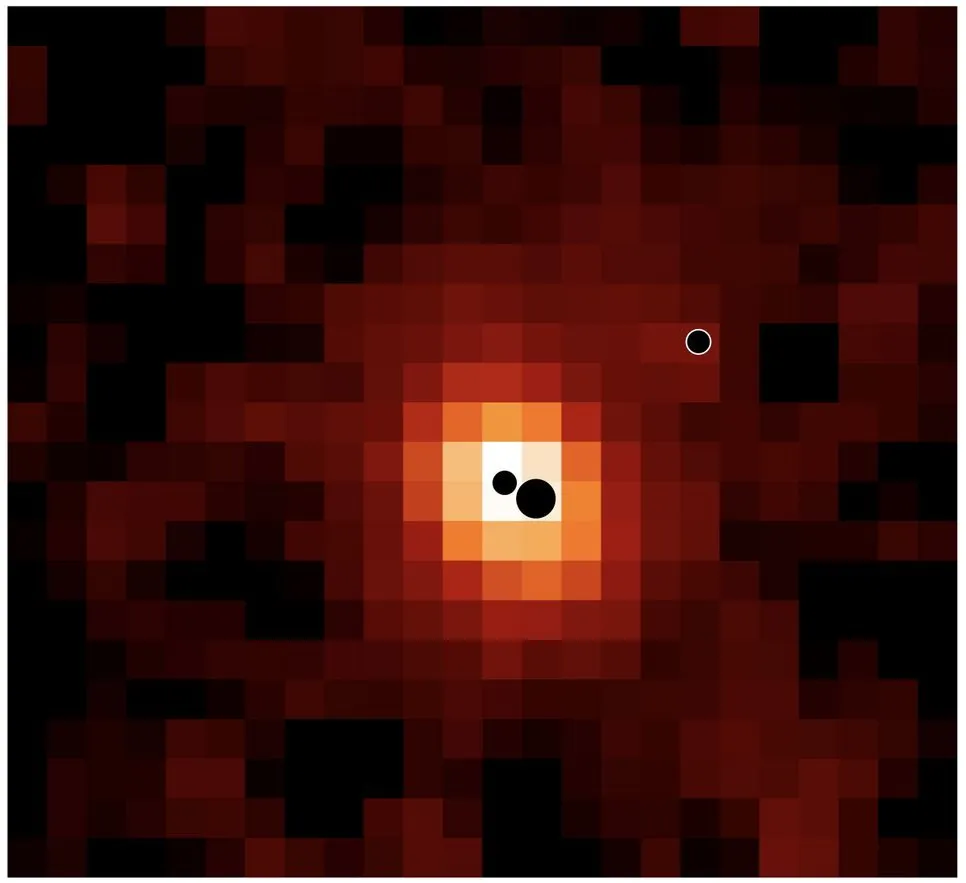
Map of the galaxy J0148-4214 in ionised hydrogen. The black circles mark the positions of the three black holes (not to scale). Image: © Hannah Übler.
A clue to how they grew so fast
One of astronomy’s open questions is how black holes got so big so early. “These results are extremely exciting,” says Roberto Maiolino of Cambridge, a co-author. “They suggest that black hole merging may be an additional, fast route for their rapid growth in the early Universe.”
The third black hole may be the remnant of an earlier merger, kicked out of the centre by a gravitational recoil, or it may be slowly moving inwards. Without Webb’s NIRSpec spectrograph, which analyses light point by point across the galaxy, the team thinks only one of the three would have been detected. That is why the authors believe other distant galaxies may hide several black holes that have not yet been found.
Images courtesy of the Max Planck Institute for Extraterrestrial Physics.