Warwick astronomers find the first known green star, a white dwarf
WD J1330+6435 has an atmosphere laced with rocky debris rich in sodium, calcium and lithium, which turns it green. No one has seen it that way with their own eyes: the University of Warwick team worked out its colour from its light spectrum.

“Imagine standing on a planet and looking up at a green star. It feels like something out of science fiction.” That’s Mark Hollands, an astronomer at the University of Warwick in the UK, who led the study that identified WD J1330+6435, which his team says is the first known genuinely green star in the galaxy. The work is published in RAS Techniques and Instruments, and Warwick announced it on 15 October.
There is an important caveat: no white dwarf is close enough for its colour to be seen directly. The team calculated it from each star’s spectrum, the “fingerprint” its light leaves when split by wavelength, and ran it through a model of human colour vision.
Sodium that eats the orange
White dwarfs are what is left of stars like the Sun once they burn out. They were thought to follow the same rule as almost every other star, with colour set by temperature: orange when cool, white when warm, pale blue when hottest.
WD J1330+6435 breaks that rule. At roughly 4,000 degrees Celsius, it has pulled rocky material from its planetary system into its atmosphere, enriching it with calcium, lithium and sodium. Because these atmospheres are extremely dense, the sodium absorbs the orange part of the light, “leaving behind a ghostly green glow”, Hollands says.
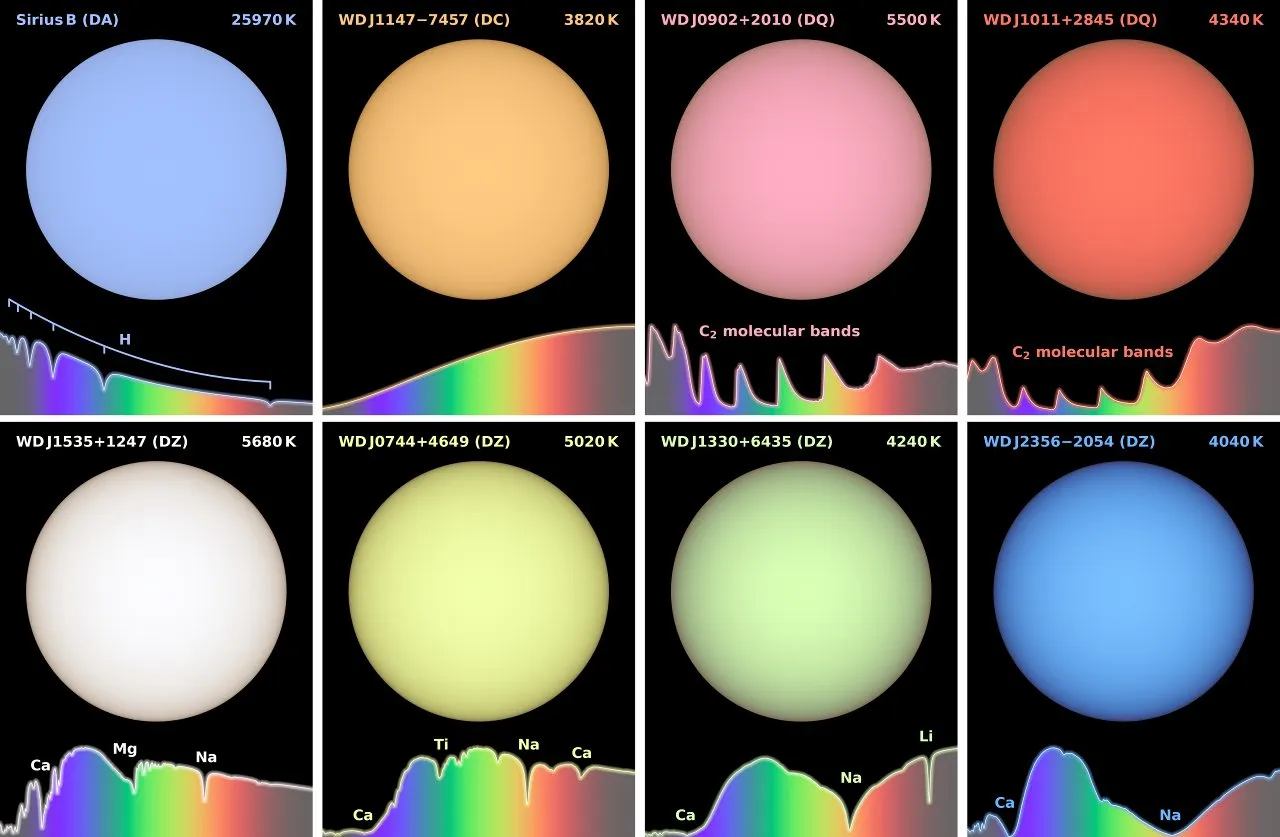
Simulated colours of eight white dwarfs based on their spectra; the green one is WD J1330+6435. Image: Mark Hollands / University of Warwick.
Pink, yellow and mostly white
The study found other colours too. Carbon-rich white dwarfs come out pink or purple, while those that have swallowed debris from asteroids and comets lean towards yellow. WD J1011+2845, 48 light years from Earth, may be the reddest star ever recorded, with a salmon-pink glow.
To see how common these odd colours are, the team looked at the 151 white dwarfs within about 65 light years. Five had unusual colours (two yellow, three pink), which suggests that roughly one in thirty would shine that way. The rest settle another question: the typical white dwarf is not blue, as is often assumed, but white. The sample’s median colour temperature was about 6,800 kelvin.
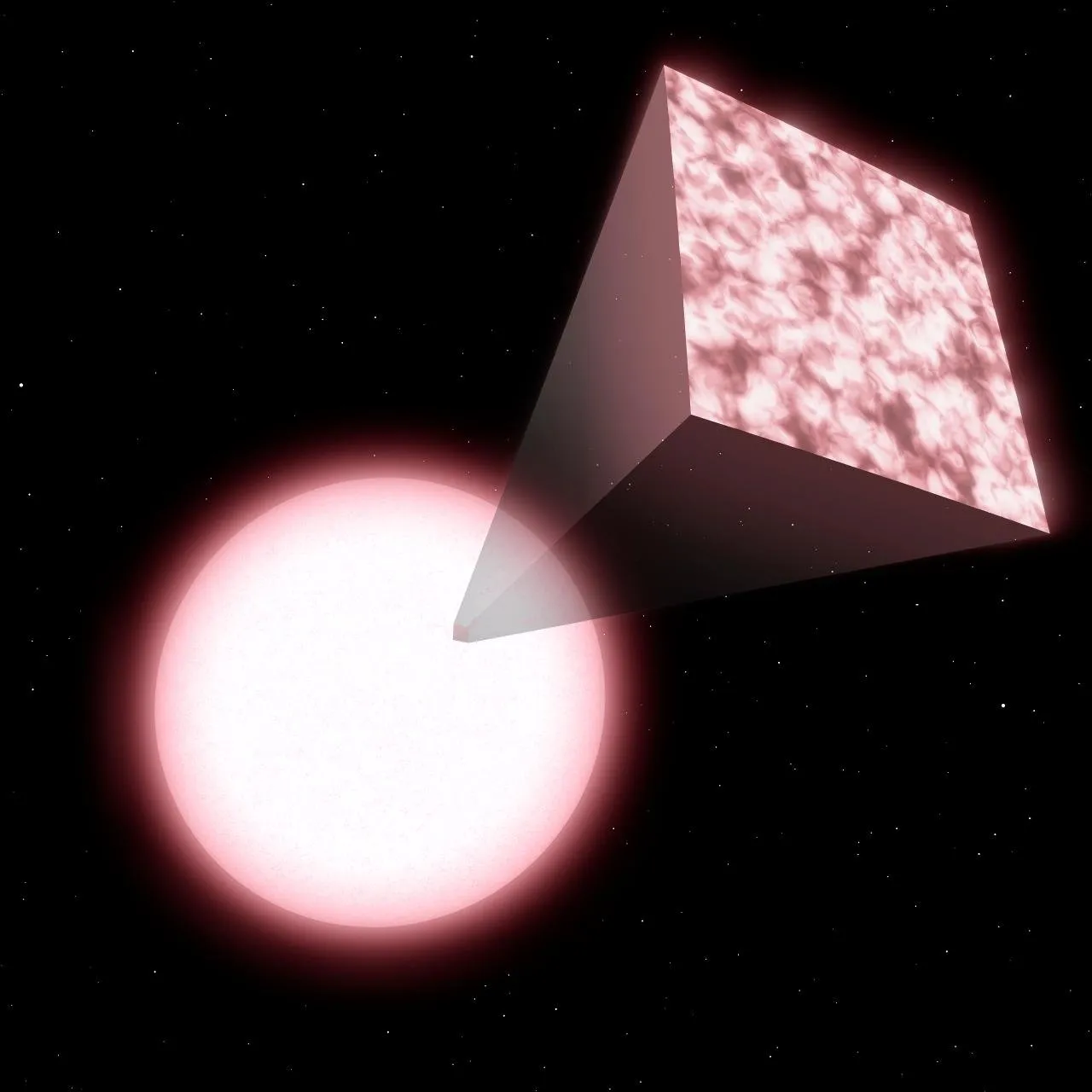
Artist’s impression of WD J0902+2010, a white dwarf that looks pink because of the carbon in its atmosphere. Image: Mark A. Garlick / University of Warwick.
The paper, “Any colour you like”, is available under DOI 10.1093/rasti/rzag069.
Images courtesy of the University of Warwick.