Touchscreen woven into a sleeve survives 50 machine washes
Engineers at the National University of Singapore have threaded the first touchscreen into a garment: the sleeve shows images and video, responds to a finger and still works after 50 washes. It is a low-resolution lab prototype with no sale date, published in Nature.
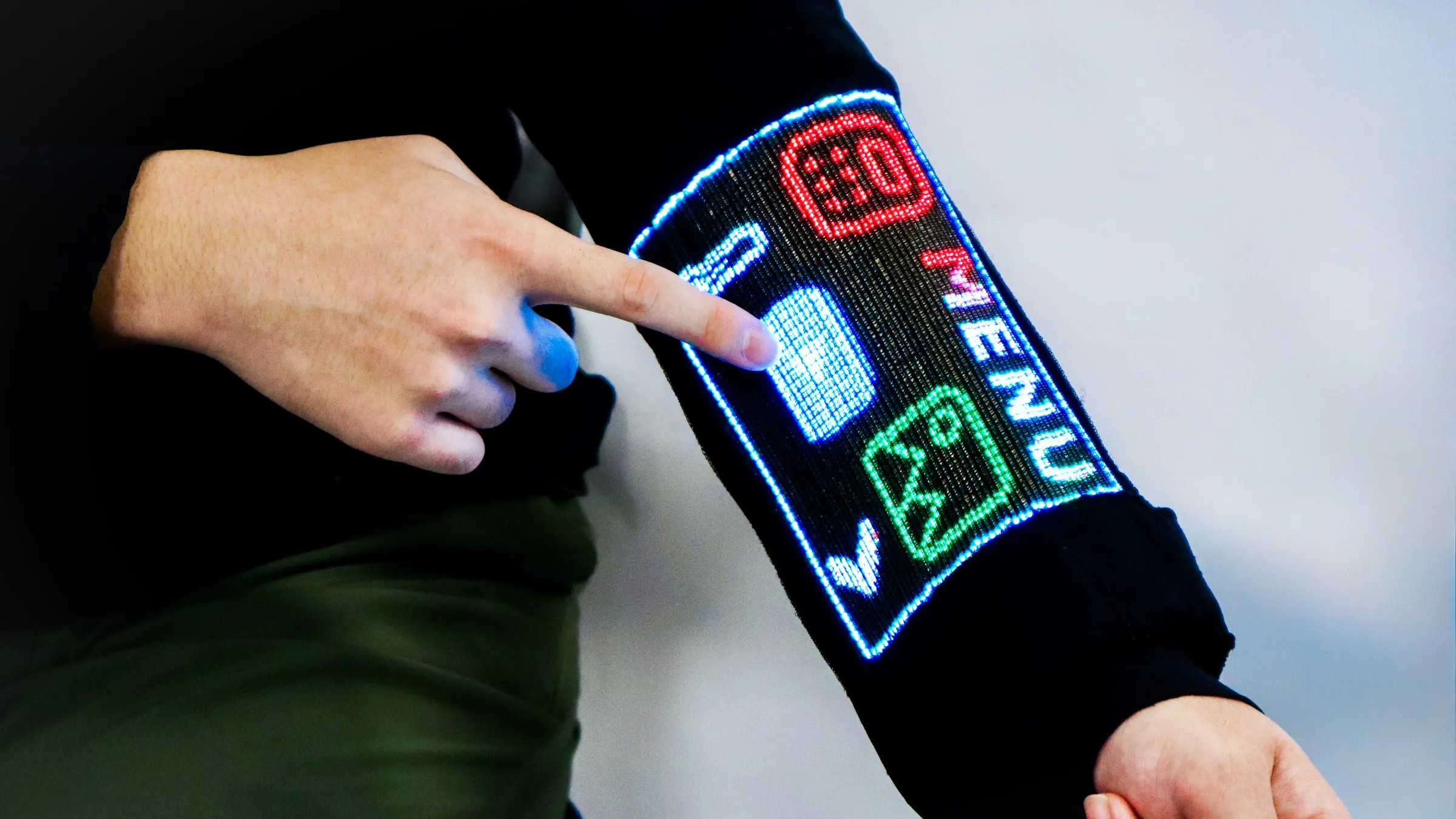
A finger taps a sleeve and a menu lights up: calculator, photo gallery, compass. Researchers at the National University of Singapore (NUS) have built what the university calls the first touchscreen integrated into a garment. The work, led by Assistant Professor Tural Khudiyev, was published in Nature on 21 October.
It is a prototype. The display is 96 by 54 pixels, far from a phone screen, and the team gives no date for anything you could buy.
Threads that are pixels and sensors at once
The key is a fibre one millimetre thick that does two jobs at the same time: it gives off light and it feels your finger. Inside is a strip of LEDs, with a layer beneath that detects where you press so the nearest pixel lights up. To make it, the team joined more than 5,000 chips through more than 20,000 connections along a thread 10 metres long.
They wove 54 of those fibres into the forearm of a sleeve. The result is a display of 168 by 105 millimetres that plays video at 30 frames per second, registers several touches at once and receives images over Bluetooth. Other fibres carry a microphone, a speaker and sensors; worn under the arm, the sleeve reads body temperature and displays it.
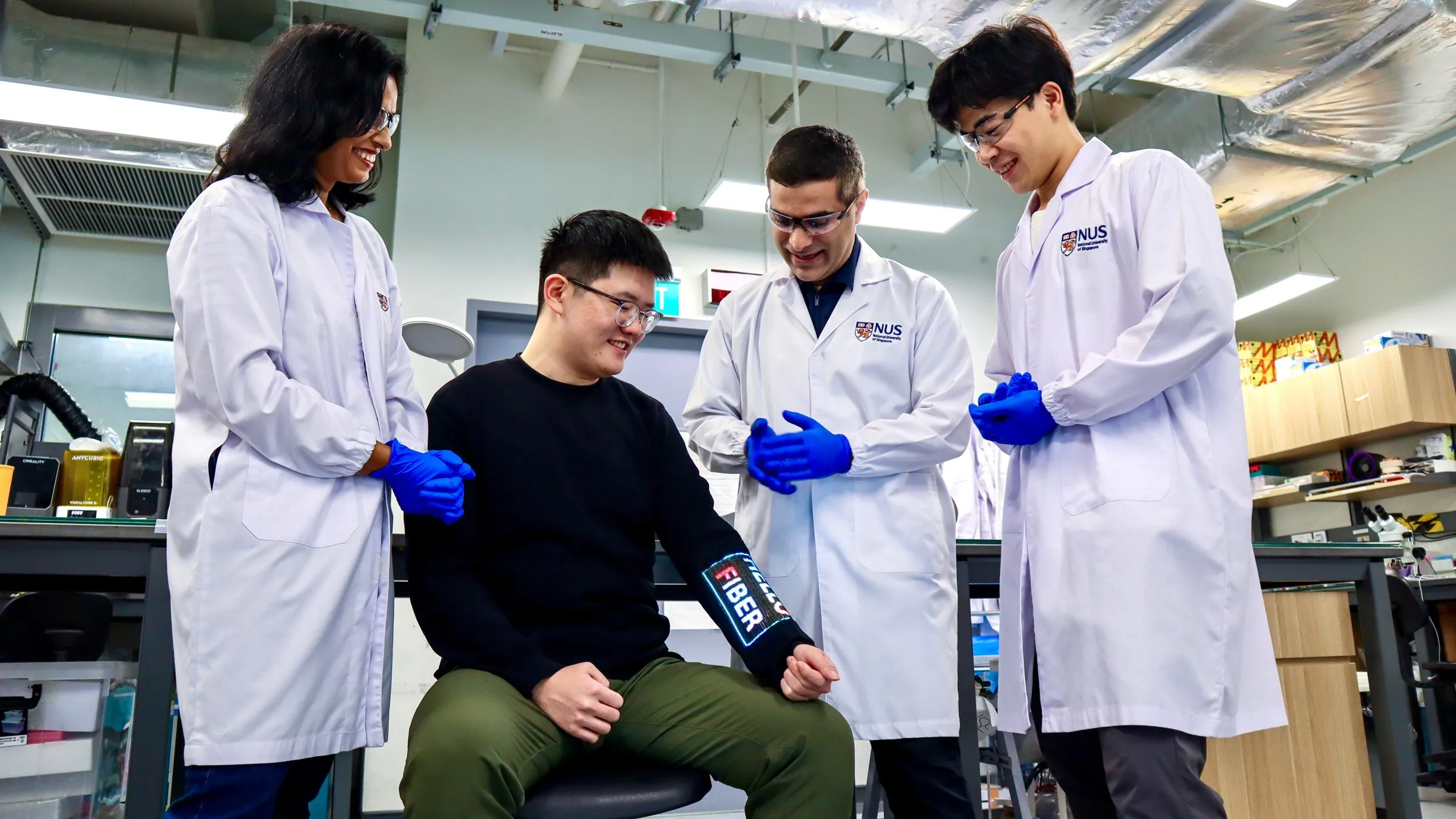
Tural Khudiyev (second from right) with Heng Fu (right), Ziang Li (seated, wearing the sleeve) and Swetika Chaturvedi (left). Photo: NUS.
Still a piece of fabric
What makes this good news is that the clothing stays clothing. According to NUS, light output and touch response were nearly unchanged after 50 detergent washes in a typical washing machine and 1,000 bends. The display is as breathable as cotton, polyester and denim and stays within safety limits for skin contact. If one fibre fails, its neighbours keep working.
Clothes like this could show information without a rigid screen. Khudiyev sees healthcare as the most promising use: “A garment could continuously collect physiological information through fibre-based sensors and allow the wearer to access and interact with that information directly through their clothing.” For someone who needs to keep an eye on their temperature or activity, the reading would be right there on their sleeve.
Sharper screens, thinner threads
Smaller chips and thinner fibres, both compatible with the method, could make the display sharper and larger, and the fibres could be knitted, woven or embroidered on standard industrial machines. The team’s next step is higher resolution, with more sensing and artificial intelligence built into the fabric itself.