Spanish scientists map how the brain's relay centre forms
The Institute for Neurosciences (CSIC-UMH) in Alicante, Spain, has built the first atlas of the embryonic thalamus, showing cell by cell how mice develop the neurons that relay information from the senses and movement. It is basic research in mice with no immediate clinical use, but it gives scientists a reference for studying problems in brain development.
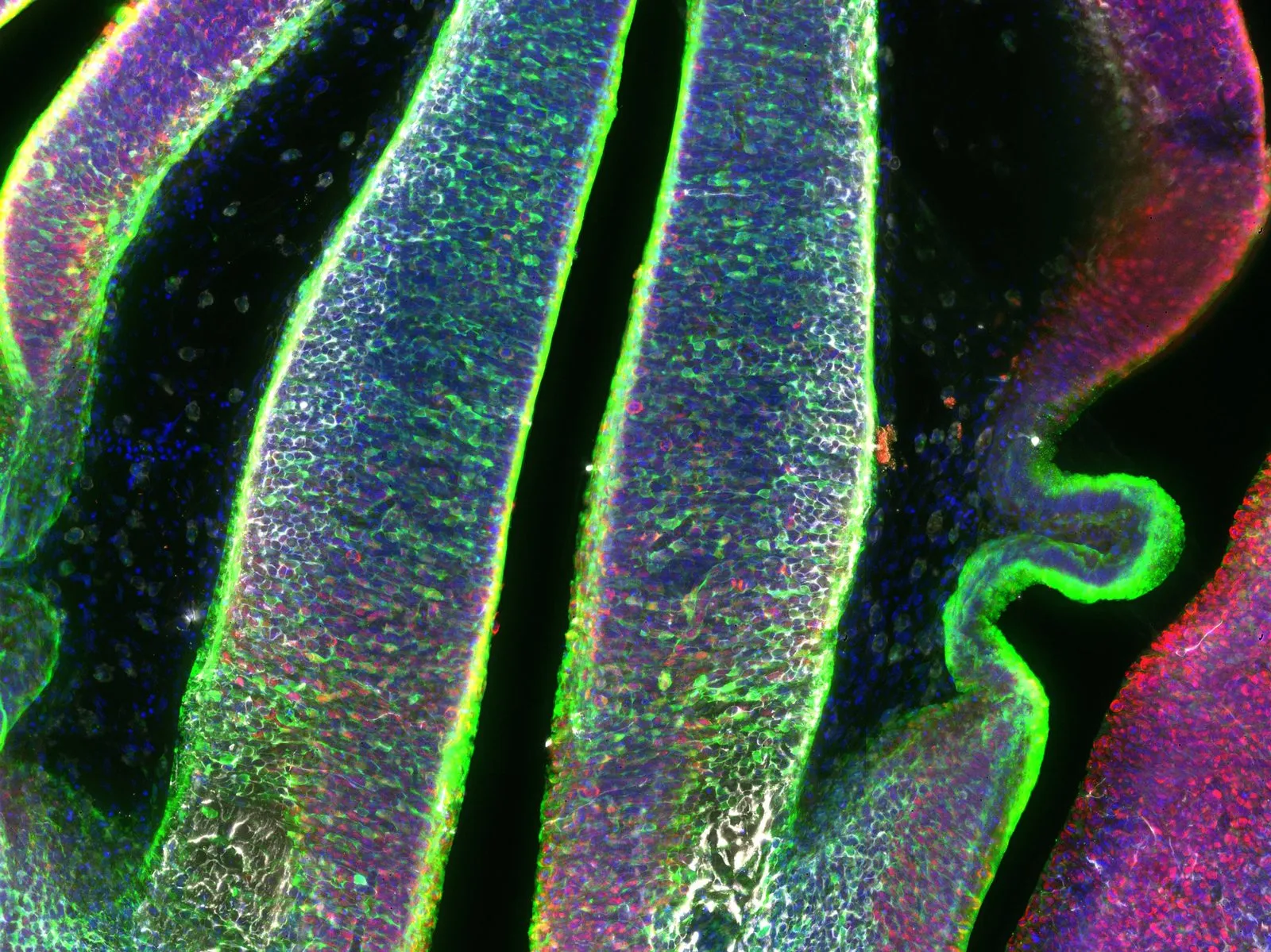
Almost everything we see, hear or touch passes through the thalamus before it reaches the cerebral cortex. Researchers at the Institute for Neurosciences (IN CSIC-UMH) near Alicante have reconstructed how this part of the brain forms, following thousands of neurons in mouse embryos from their earliest stages until they specialise.
The work, led by Guillermina López-Bendito with José P. López-Atalaya’s group, is published in Nature Neuroscience. It is the first multiomic atlas of the embryonic mouse thalamus: for each cell, the team measured which genes were active and which stretches of DNA were open to regulate them.
Two paths, early on
The main finding is that thalamic neurons don’t follow a single route. Early in development they split into two lineages: one forms the sensory nuclei, the other the nuclei linked to movement and cognition. The two also progress at different speeds, with sensory circuits maturing first.
The team also found an unexpected stop along the way: before specialising, some sensory neurons pass through a state similar to that of “higher-order” nuclei, which link brain regions to each other. They confirmed it with genetic labelling that tracks each cell’s fate.
A gene for vision
The atlas pointed to the gene Sp9 as key for the visual pathway. When the researchers reduced its activity in mouse embryos, visual neurons did not properly acquire their identity. “This shows the gene plays a key role,” López-Bendito told CSIC.
What it could offer
According to CSIC, the atlas provides a reference for better understanding changes that may be linked to neurodevelopmental disorders and neurological diseases. For now it is basic research in mice: the next step is to use the map to study how thalamic circuits are built and what goes wrong when they form badly.
The study was funded by Spain’s Ministry of Science, Innovation and Universities, the European Research Council (ERC Advanced Grant), the “la Caixa” Foundation, the Valencian government’s PROMETEO programme and the Severo Ochoa programme.