Flexible organic solar modules hit 18.8% efficiency and last 2,000 hours
A team at the Ningbo Institute of Materials Technology and Engineering (Chinese Academy of Sciences) has anchored one of the layers in organic solar cells with an ultra-thin film of indium chloride. These are lab results, on 15.6 cm² modules, published in Joule: the technology is still a long way from rooftops.
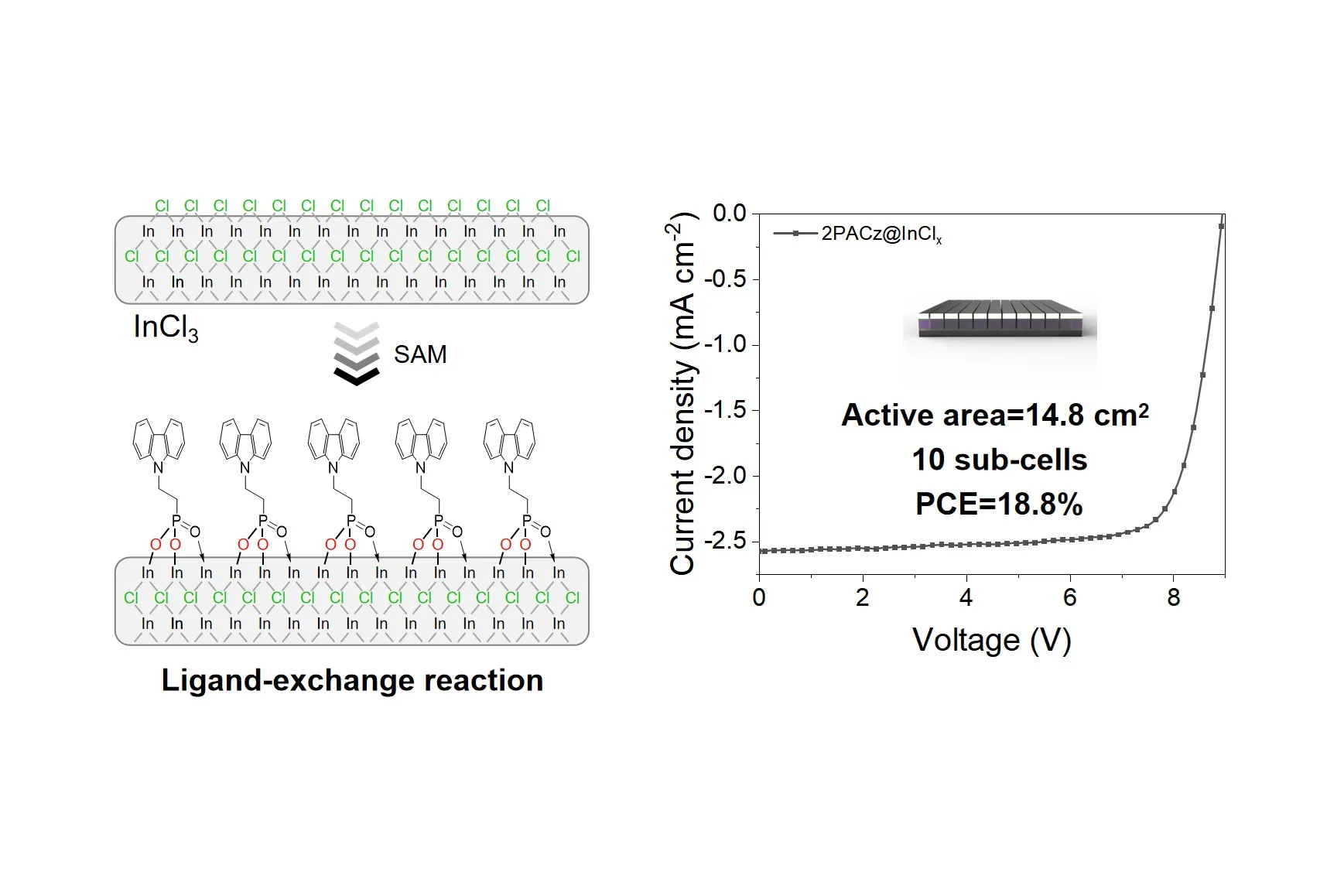
An ultra-thin film of indium chloride is at the heart of this result. With it, a team at the Ningbo Institute of Materials Technology and Engineering (NIMTE), part of the Chinese Academy of Sciences, has made organic solar cells lose less of their output to heat and light. The work was published in the journal Joule on 21 October.
Organic cells use carbon-based molecules instead of silicon. They are light, thin and flexible, which is why they are being considered for windows, car roofs and smartwatch covers. Their weak spot is that they don’t last long. This is lab work: the technology is not on sale yet.
Molecules that stay put
The problem lay in a very thin layer of molecules that sits on the electrode and helps draw out the current. Under light and heat, those molecules came loose. The team, led by Professor Liu Quan, added an indium chloride film underneath. When heated, it reacts and forms bonds between indium, oxygen and phosphorus, locking the molecules in place.
With this technique, small cells reached 20.4% efficiency and modules with a 15.6 cm² aperture reached 18.8% over their active area, which the authors describe as a record for that size. After 2,000 hours of non-stop operation under light at 25 °C, the modules kept more than 85% of their starting output.
From lab bench to factory
Those 2,000 hours were in the lab, not years of sun on a roof. What this study adds is scale: according to the Chinese Academy of Sciences, the technique works for making larger modules without losing quality, which is what mass production needs.