No-touch technique reveals a near-invisible layer over the Chauvet cave paintings
Using ultraviolet light and a fibre-optic probe, without taking a single sample, a team from Sorbonne Université and France's CNRS detected a thin film of calcite over some of the drawings in Chauvet Cave, made around 37,000 years ago. The method will help monitor the walls without harming them. The authors also suggest, as a hypothesis still to be confirmed, that some lines were drawn with hot charcoal.
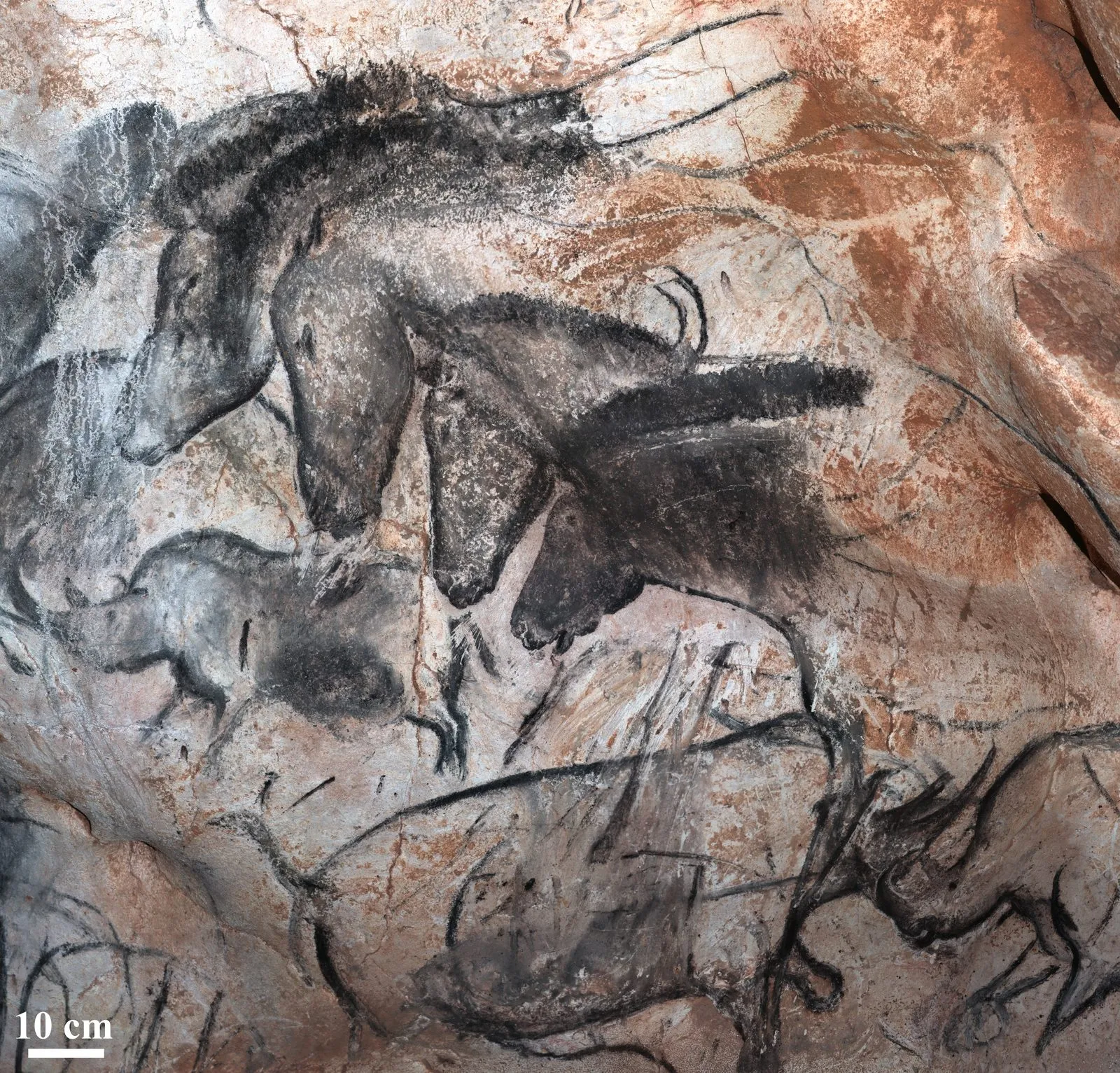
The horses, lions and rhinos on the walls of Chauvet Cave in southern France have been there for around 37,000 years. A team from Sorbonne Université and the CNRS has detected a translucent film of calcite over some of them, invisible to the naked eye, that may act as a natural varnish. And they saw it without touching the rock.
The study, led by Yohan Boulard and Philippe Walter, was published in ACS Omega. The technique will help monitor the walls without damaging them. The hot-charcoal idea the paper also raises is, for now, a hypothesis.
Ultraviolet light from 2.5 metres away
In Chauvet, visitors, scientists included, can only move along narrow walkways. So the team worked from a distance: a carbon-fibre pole with a three-metre fibre-optic bundle, an ultraviolet light and a battery pack. They lit the wall from up to 2.5 metres away and analysed the faint glow the rock sent back.
Limestone and calcite are almost identical chemically, but they glow differently because of their impurities. The charcoal of the drawings does not glow at all. Over the black lines of the Horses Panel, the light came mostly from calcite: a thin layer covers the drawing and, while it stays thin, protects it. If it thickened and turned opaque, it could hide it.
“Our methodology is much like forensic investigation,” says Walter.
A clue pointing to hot charcoal
Beneath some strokes, an unexpected orange glow appeared. In the lab, only heated limestone and heated calcite gave a similar signal. The authors suggest some lines were drawn with charcoal that was still hot, altering the rock underneath. That still needs confirming.
The researchers think the method could be used on other painted caves and in other fields, from forensic science to monitoring biofilms.