Trees can sense their own shape and pull themselves straight, French scientists find
A team from INRAE and the University Clermont Auvergne found that young poplars use tension wood like a muscle, first on one side of the stem and then on the other, to correct their posture based on their sense of their own curve. Understanding it could help produce better timber and trees that cope better with storms and landslides. The catch: it is a lab experiment on young trees of a single species.
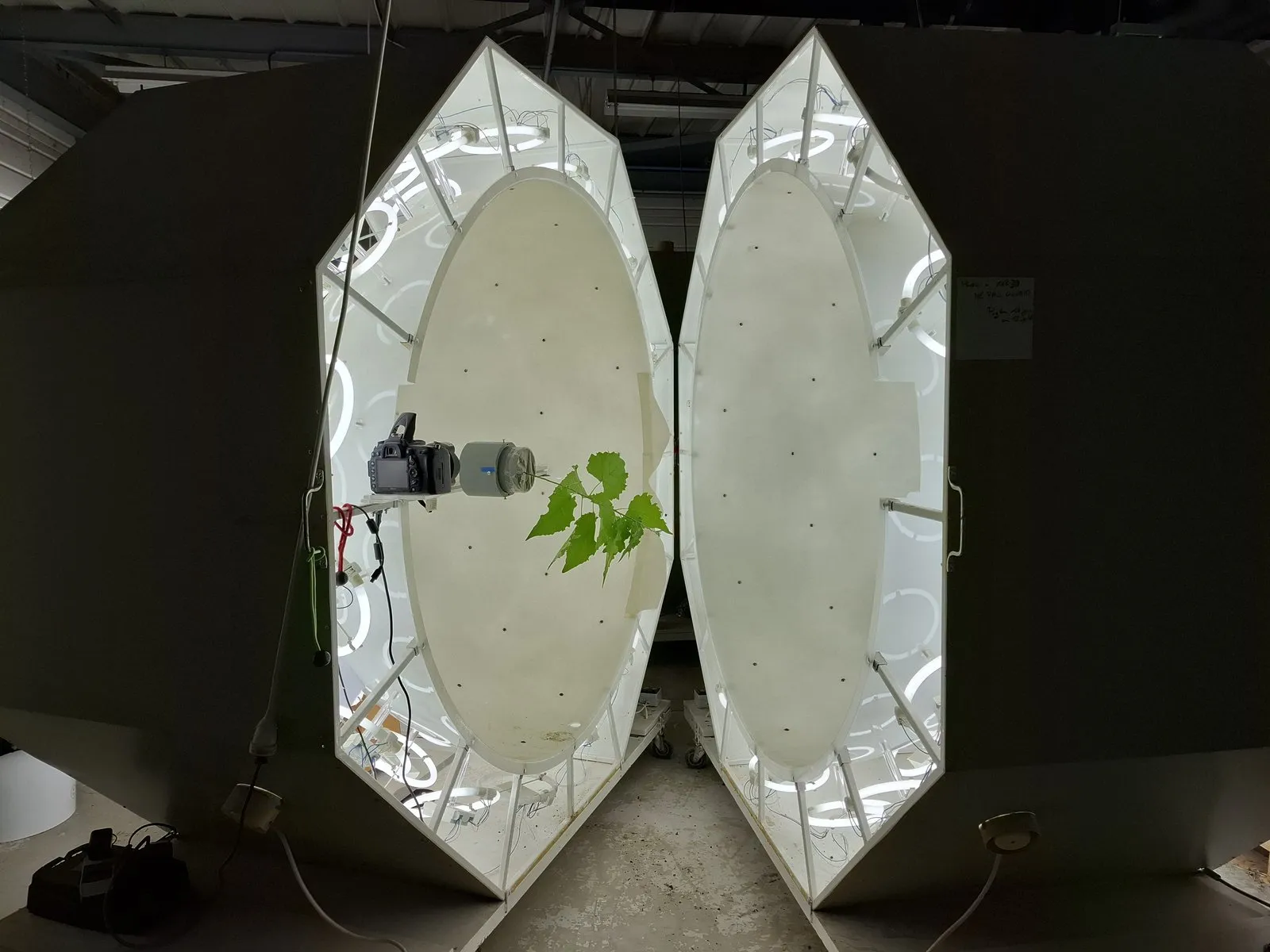
A young poplar lies on its side, slowly turning on its axis inside a sphere flooded with light from every direction. It cannot tell where the ground is or where the sun is. It has only one sense left: the sense of its own shape. Yet within a few weeks, its bent stem is straight again.
That is the experiment with which a team from INRAE and the University Clermont Auvergne, in France, worked out how trees straighten themselves. The study is published in New Phytologist.
A muscle made of wood
The ability to sense the position of your own body is called proprioception. It was long thought to be unique to animals, until in 2012 a team involving INRAE showed that plants have it too. What was missing was the mechanism.
The researchers first laid young poplars flat. After about ten days, the stems had curved upwards thanks to tension wood, a type of wood that contracts like a muscle and pulls on the upper side of the stem. Then they moved the trees into the clinostat, the rotating machine.
There, the tree stopped forming tension wood on the upper side and started forming identical wood on the opposite side. That second layer pulled the other way, like the opposing muscle in an arm, until the stem was straight. Until now, scientists thought tension wood only formed on the upper side.
Straighter trees in a stormier world
According to INRAE, combining what trees sense about light and gravity with an awareness of their own shape helps them recover when a storm or landslide knocks them askew, which matters more as the climate changes.
There are practical uses too. “Poor coordination in the successive activation of tension wood results in excessive internal tension, which can affect wood quality,” says Bruno Moulia, INRAE research director. The aim, he says, is trees “as straight and as relaxed as possible”. The team also points to breeding cereals that are less likely to be flattened by wind and rain.
The study used young trees of a single species in the lab; the next step is to see how the mechanism works in mature trees and in the forest.