Strength exercises in the pool build bone in part of the hip in older women
In a University of Valencia trial with 98 women around 68 years old, those who did strength work in water for eight months gained more bone density in Ward's triangle, a region of the hip, than those who exercised on land or did nothing. The gain was limited to that area and it is not yet known whether it prevents fractures.
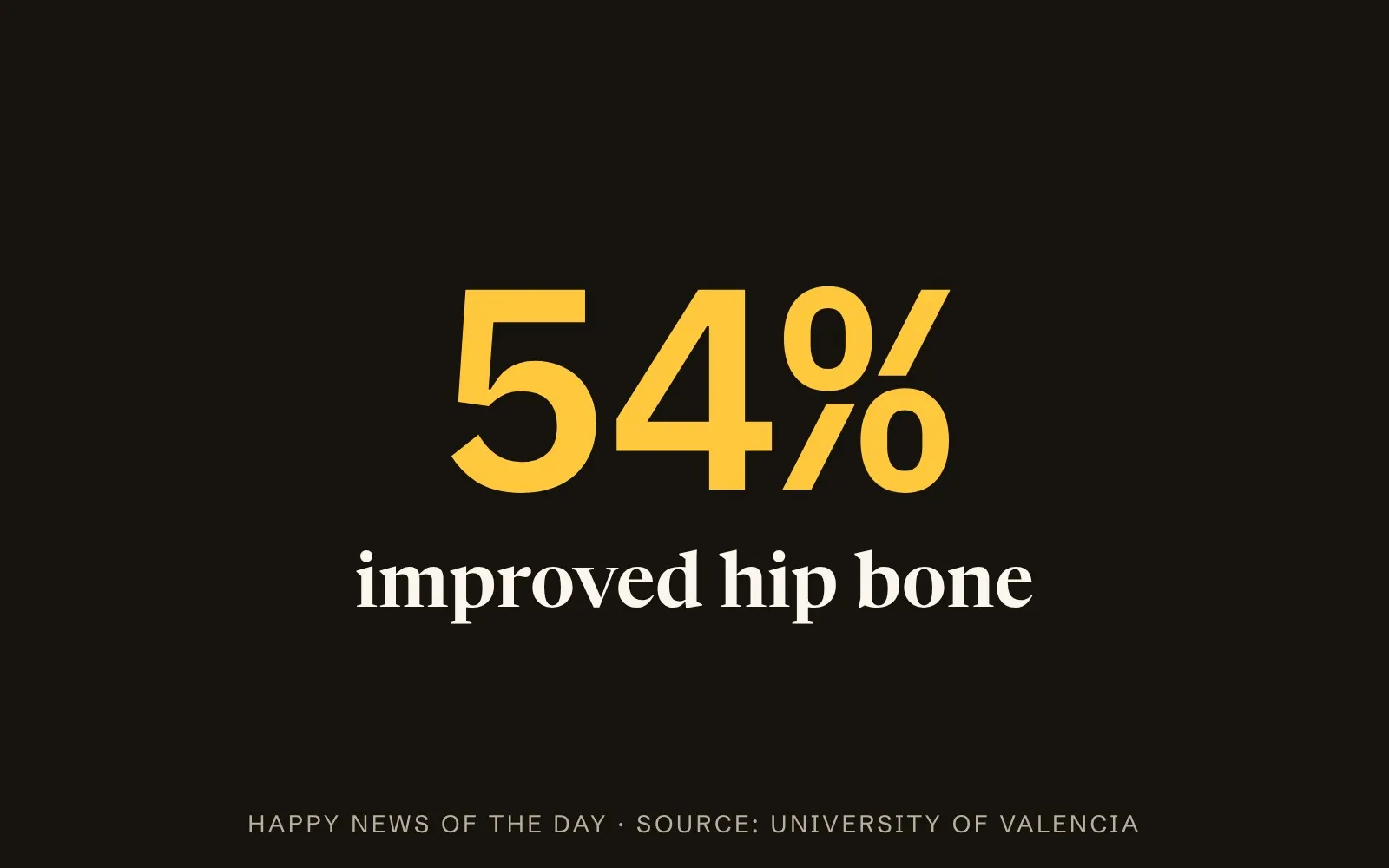
Two one-hour sessions a week, for eight months, in a swimming pool. On that strength programme, 54% of the older women in a University of Valencia (UV) trial improved bone density in one specific part of the hip beyond the threshold set by the researchers. Among those who exercised on land the figure was 33%, and among those who followed no programme, 10%. It is a trial with 98 participants, the gain was seen only in that region, and it is not yet known whether it means fewer fractures.
Resistance, speed and progression
The study, by the Prevention and Health in Exercise and Sport (PHES) group led by Professor Juan Carlos Colado, is published in Archives of Gerontology and Geriatrics. It analyses three groups from a larger randomised controlled trial, made up of women with an average age of about 68 and, according to the paper’s title, overweight.
One group did strength exercises in water, another exercised on land and the third carried on as usual. Sessions lasted 60 minutes, twice a week for 32 weeks, supervised by professionals. In the pool, the women combined arm and leg exercises with devices that increase water resistance, and were asked to move as fast as they could while keeping good form. The workload rose gradually, tailored to each participant.
In water, the faster you move, the more it pushes back. That principle lets a pool become a place to build real strength, not just to do gentle exercises.
Ward’s triangle, the area that improved
Bone scans showed that the pool group improved significantly more than the other two in bone mineral density and T-score in Ward’s triangle, a region of the hip. Results were not the same across every part of the skeleton that was measured.
“It is not simply a matter of telling older people to go to the pool,” Colado says. “What really matters is which exercises they do, with what resistance, at what speed and with what progression.”
What we still don’t know
The study cannot tell how much each part of the programme contributes. The researchers call for new trials to confirm the results and to check whether they lead to clinical benefits such as a lower risk of fractures. In the meantime they see a practical use: public pools and active-ageing centres could offer supervised, progressive strength programmes with the facilities they already have.
Sources
- University of Valencia · Press release on the PHES group study: strength in water and hip bone health in older women (21-10-2026, in Spanish)
- Archives of Gerontology and Geriatrics · Juesas, Babiloni-Lopez, Gene-Morales and Colado: Effects of aquatic and land-based resistance training on hip bone health in overweight older women (2026)