15-minute saline injection eases carpal tunnel for six months in Indian trial
It is a small trial of 63 patients at two hospitals in India: injecting saline around the nerve under ultrasound guidance kept symptoms improving at six months, while those given a steroid injection alone relapsed. The authors say larger studies are needed.
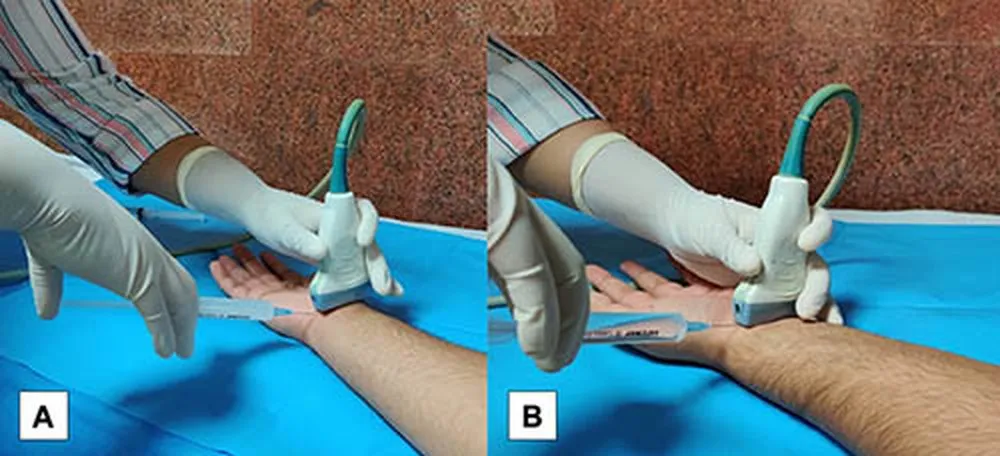
Tingling, numbness and pain in the hand: that is carpal tunnel syndrome, which happens when the median nerve gets squeezed as it passes through the wrist. A trial in India of patients for whom nothing else had worked has tested a simple alternative: injecting saline around the nerve to free it.
The study, published in the journal Radiology, is small: 63 patients followed for six months. It was led by Anindita Bose of Mahatma Gandhi Medical College and Hospital in Jaipur and Anupama Tandon of the University College of Medical Sciences and Guru Teg Bahadur Hospital in Delhi.
Saline instead of steroids
The technique is called hydrodissection. Using ultrasound as a guide, the doctor injects fluid around the nerve to separate it from the tissue pressing on it and help it move freely again. It is usually combined with steroids; here it was tested on its own.
Patients were split into three equal groups: hydrodissection with saline, hydrodissection with saline plus a steroid, or a steroid injection alone, the usual option. All three improved at four weeks. At 12 weeks and six months, both hydrodissection groups kept improving, while symptoms came back in the steroid-only group.
Adding a steroid to the saline gave no significant extra long-term benefit. “Steroids carry risk of localized skin changes, fat thinning and tendon weakening,” Tandon notes.
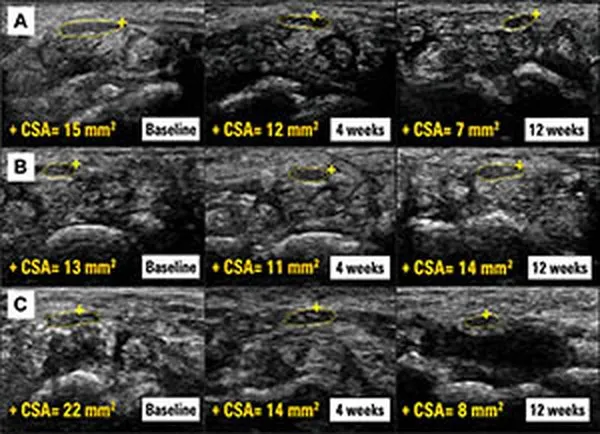
The median nerve’s area (outlined in yellow) in three patients: it shrinks after hydrodissection with saline (A) or saline plus steroid (C), but not with a steroid alone (B). Image: RSNA.
A quarter of an hour, then back to work
According to RSNA, the procedure took 15 minutes on average, needed no anaesthetic or hospital stay, cost little, and patients could return to work within an hour. There were no significant complications.
Carpal tunnel syndrome affects roughly 5% to 10% of people over their lifetime. The authors think the technique could become an option for mild to moderate cases and could delay or even avoid surgery, but they stress that multicentre studies with more patients and longer follow-up are needed. They have already started one comparing saline with other fluids, such as dextrose.
Official RSNA images, used with permission and a link to RSNA’s press release.