Japanese team turns tumours' own carbon monoxide into a cancer drug inside cancer cells
Researchers at Japan's RIKEN have made a compound that uses the excess carbon monoxide produced by tumour cells to build, inside them, a drug that stops them growing, while barely affecting healthy cells. So far it has only been tested on cells grown in the lab, not in animals or patients.
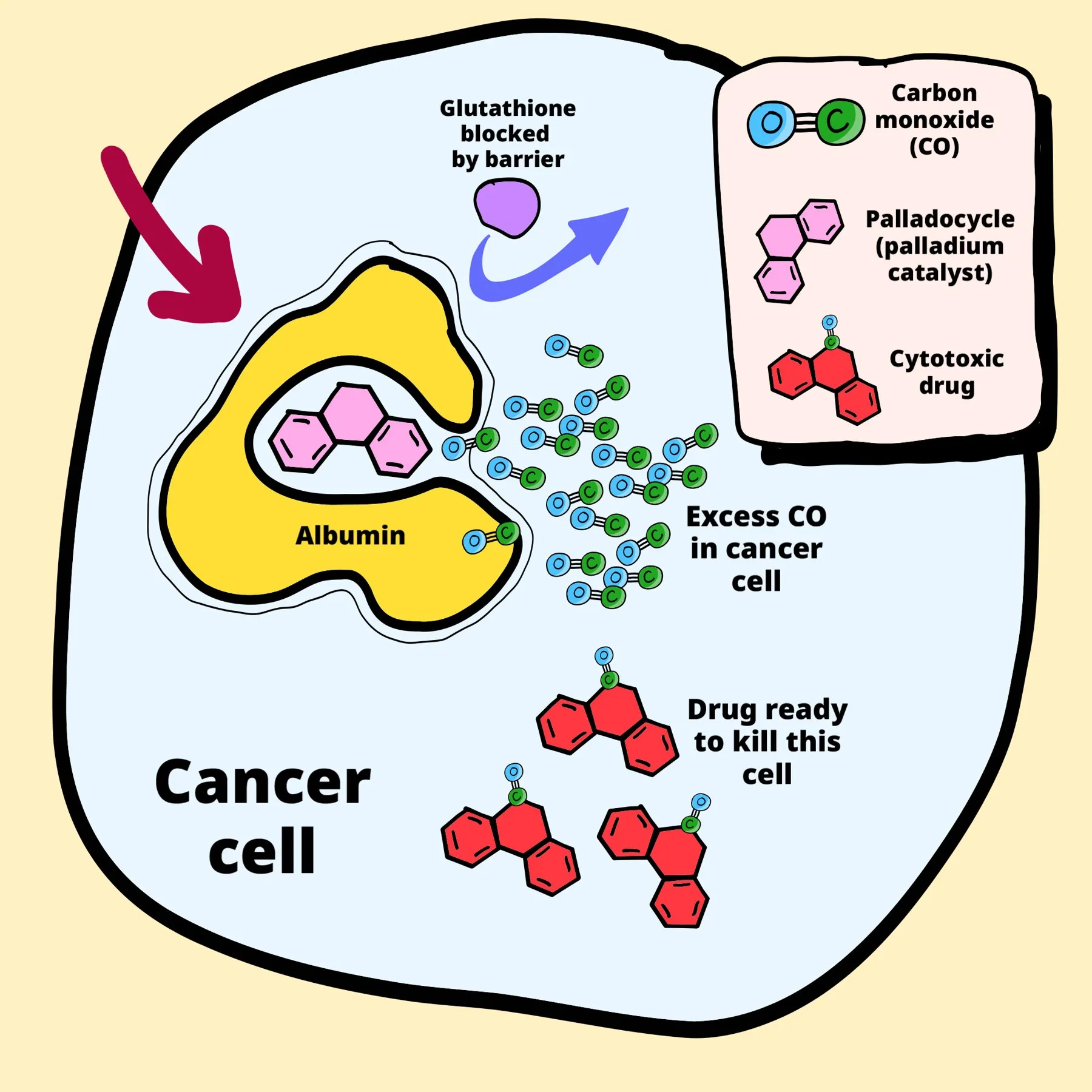
Carbon monoxide has a bad reputation, but cancer cells make more of it than healthy ones. A team at Japan’s RIKEN, led by Katsunori Tanaka, has put that surplus to work: their compound captures it and uses it to build, inside the tumour cell itself, a molecule that stops the cell growing.
The study, published in Nature Communications, is a proof of concept in cells grown in the lab. It has not yet been tested in animals or people.
A catalyst hidden inside a blood protein
Chemotherapy also hits healthy cells, which causes many of its side effects. Tanaka’s group takes a different route: deliver only the parts, and let the drug be assembled where the tumour is.
That called for a palladium catalyst, a metal chemists use to turn carbon monoxide into drugs of the phenanthridinone family. The problem is that cells are full of glutathione, a molecule that disables palladium almost instantly. The fix was to tuck the catalyst into a pocket of albumin, the most abundant protein in blood. Shielded that way, it kept working even with twenty times more glutathione than catalyst.
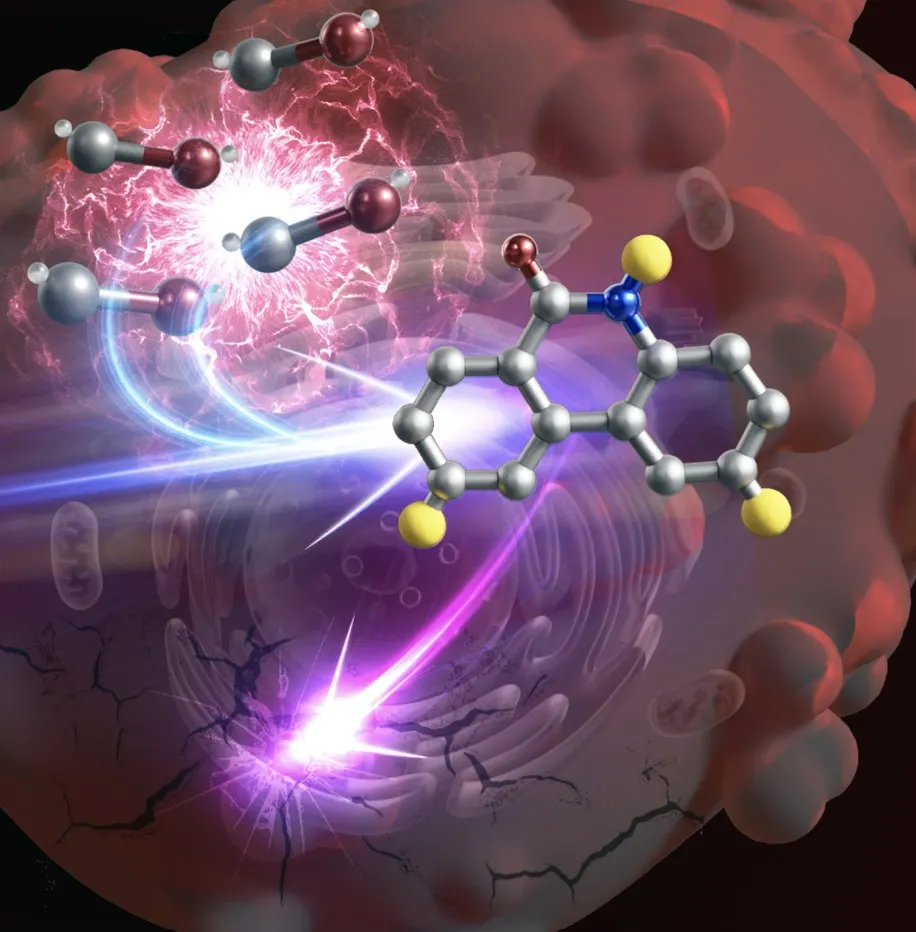
Carbon monoxide in the cancer cell is converted into a molecule with anticancer activity. Illustration: RIKEN.
More drug where the cancer is
The team tested the compound on human liver, cervical, breast and lung cancer cells: all made far more phenanthridinone than healthy cells, which made almost none. A refined version built an oxynitidine derivative, a potent anticancer molecule. In breast cancer cells, at 10 micromolar or more it almost completely stopped them forming colonies, and it also hit liver cancer cells, while barely harming healthy ones. According to RIKEN, no drug formed in blood, because carbon monoxide there is bound to haemoglobin.
That is why this is good news: it shows a way for a medicine to be made only where the cancer is, which could one day mean treatments that do less damage to the rest of the body. Tanaka calls it “an important advance” in chemistry that builds drugs inside the body.
The next step, RIKEN says, is to move from cultured cells to animal models. Until it is tested there, and then in clinical trials, nobody will know whether it works in a real tumour.