Pineapple-crown fibre and a sign-language translator win at Paraguay's youth science prize
The 24th Pierre et Marie Curie National Youth Science Prize, run by Paraguay's science council (Conacyt), the Ministry of Education and Science, the French Embassy and the Alliance Française, brought together 34 projects by secondary-school students from eight departments and Asunción. These are school projects: prototypes and first tests, not finished products.
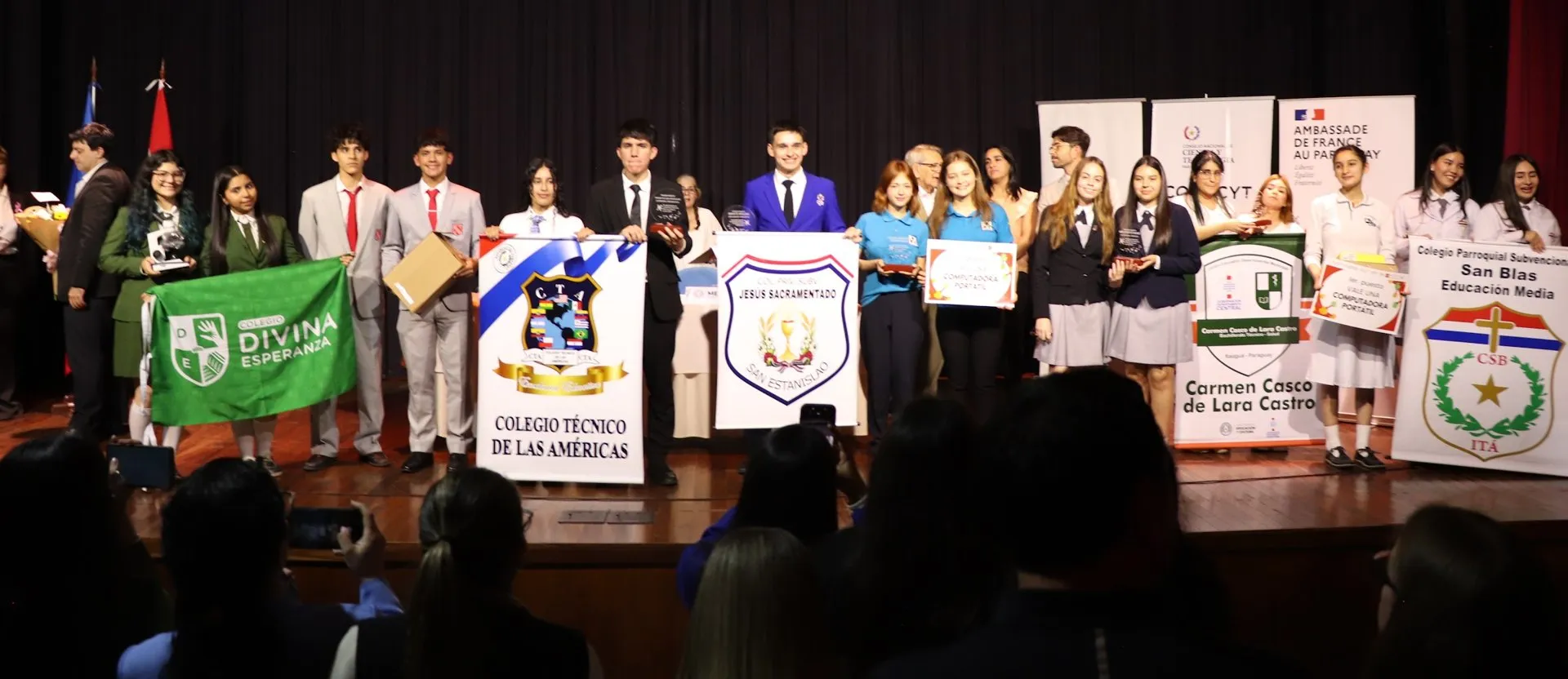
Pineapple crowns usually end up in the bin. A group of students at the Colegio Experimental Paraguay-Brasil (CEPB) in Asunción extracted fibre from those scraps and tested it as a raw material for biodegradable products. The work won first place in the science category of the 2026 Pierre et Marie Curie National Youth Science Prize, whose fair was held on 22 October at the Alliance Française in Asunción. The same project also took the award for best audiovisual piece.
From rosemary rinse to rice-husk roads
Second place in science went to an anti-dandruff hair rinse made with rosemary, burrito and ka’a he’ẽ (stevia) from Colegio Parroquial Subvencionado San Blas in Itá, Central department. Third went to EcoRoad Paraguay, a paving material made with recycled plastic and rice-husk ash and designed to stay cooler, from Colegio Iberoamericano in Asunción.
The technology category was won by a hybrid cooling prototype that combines magnetic, evaporative and heat-transfer effects, from Colegio Dante Alighieri in Asunción. Next came a study of how screens affect children at the students’ own school, from Colegio Privado Subvencionado Jesús Sacramentado in San Estanislao, San Pedro, which also had the best technology stand, and “Ñe’e Viva”, from Colegio Privado Divina Esperanza in Encarnación, Itapúa.
A sign-language translator with a webcam
The most innovative technology project was a sign-language translator that recognises gestures through a webcam using computer vision, from Colegio Técnico de las Américas in Ñemby, Central. In science, the most innovative was a wound-healing hydrogel made with cangorosa, a medicinal plant, from Colegio Técnico en Salud Carmen Casco de Lara Castro in Itauguá, Central. The best science stand was “BIOESPUMA PY”, from Centro Educativo Diocesano Monseñor Jerónimo Pechillo in Caaguazú.
Prizes included laptops, French-language scholarships, microscopes and tablets, so the teams can keep working on their ideas. Conacyt says the competition aims to spark interest in research among secondary-school students; council member Manuel Benítez highlighted its role in encouraging “curiosity and critical thinking”.
The prize is organised by Paraguay’s National Council for Science and Technology (Conacyt), the Ministry of Education and Science (MEC), the French Embassy and the Alliance Française. It was created in 2003 in honour of Pierre and Marie Curie, and 2026 was its 24th edition.