Kazakhstan releases its second tiger into the wild, 70 years after losing its own
Amur, a male tiger brought from Russia, stepped into the Ile-Balkhash reserve on 31 October, where the female Umit has been hunting on her own since July. The Ministry of Ecology wants a population that breeds by itself, but for now there are two collared adults and two cubs still under observation.
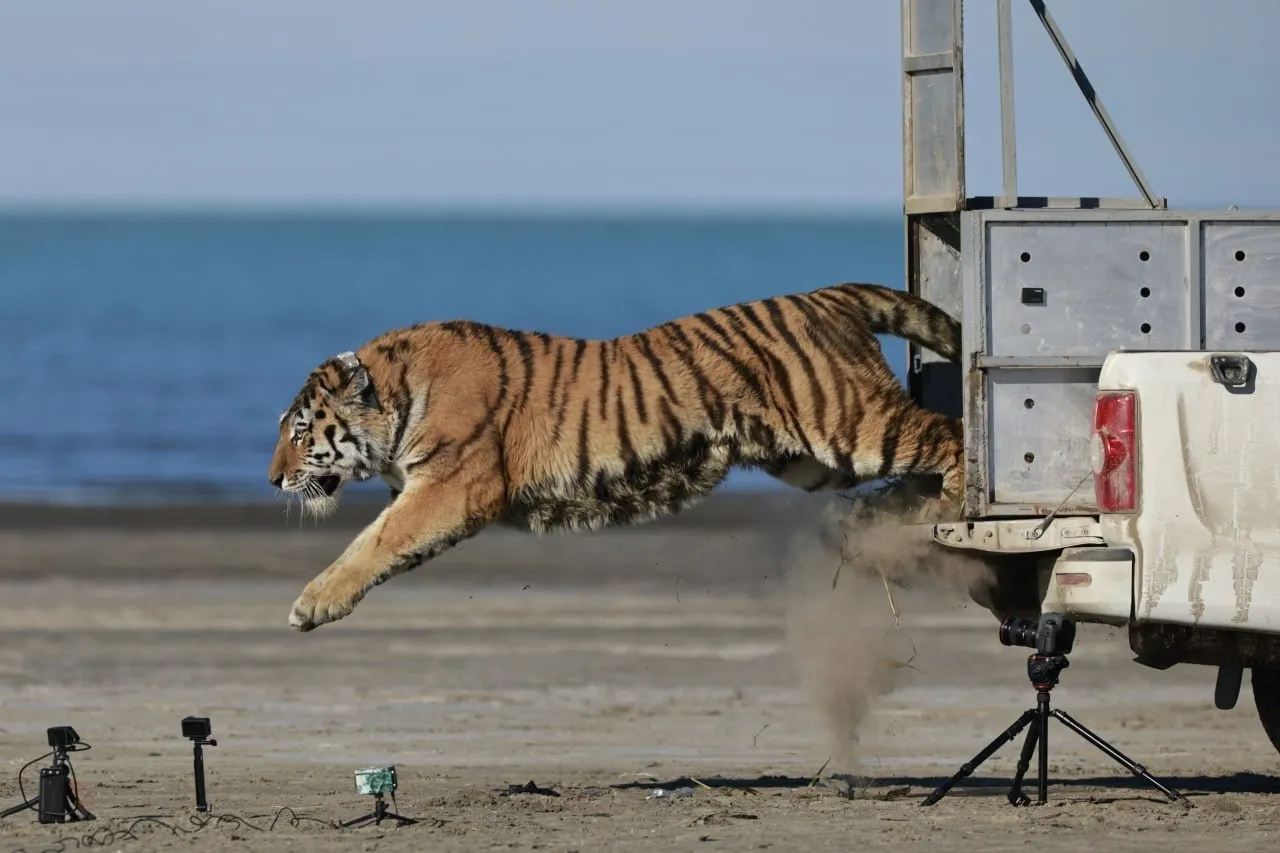
The crate door opens and Amur bounds out towards the shore. He is a male Amur tiger and, since 31 October, the second tiger living in the wild in Kazakhstan after more than 70 years without any.
The release took place in the Ile-Balkhash State Nature Reserve, in the south-east near Lake Balkhash. This was home to the Caspian, or Turanian, tiger, a subspecies that disappeared from Kazakhstan in the mid-20th century because of habitat loss, poaching and a shortage of prey.
Umit led the way in July
The first was Umit, a female released on 31 July. According to the Ministry of Ecology and Natural Resources, she is still exploring the reserve and hunting on her own, tracked by a satellite collar. Amur now wears one too.
Both arrived in May from Russia’s Khabarovsk Territory with two cubs, all four caught in the wild. The cubs remain under supervision; a decision on releasing them will come once they are old enough and pass their assessments.
Before the release, specialists checked Amur’s health, his hunting, whether he could find food alone and how he reacted to people. “Every tiger release carries significant responsibility,” said Daniyar Turgambayev, chairman of the Forestry and Wildlife Committee.
Deer and kulans came first
The reserve was set up in 2018, and the work started with food: Bukhara deer and kulans, a wild Asian ass, have been moved in. Another 30 kulans arrived from Altyn-Emel National Park in September.
The programme is run by Kazakhstan and Russia, with the Amur Tiger Centre and support from WWF. “Our main goal is not simply to return these predators to their historical habitat, but to establish a sustainable population capable of living and reproducing independently in the wild,” said minister Alibek Kuantyrov.
That will take more tigers, and cubs born in the reserve. The next step is deciding when the two cubs go free.