Fire salamanders glow green and cyan under UV light, scientists find
A team from the Natural Sciences Museum of Barcelona, Spain's Institute of Evolutionary Biology (CSIC-UPF) and the Max Planck Institute for Chemical Ecology has found that the fire salamander is biofluorescent: under ultraviolet light it gives off a blue-green glow, mostly from its skin glands. What causes it, and what it is for, is still unknown.
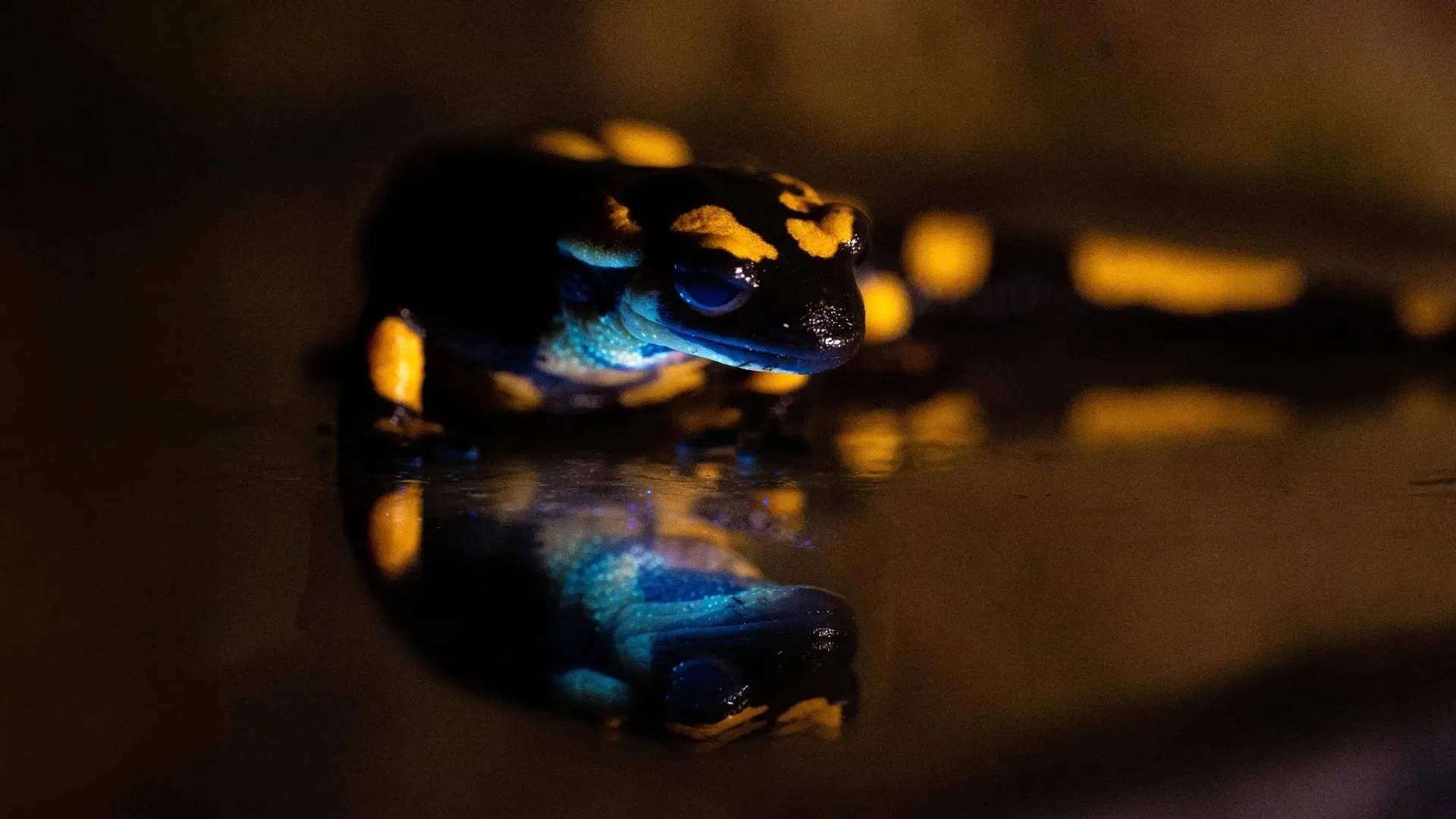
Shine an ultraviolet lamp on a fire salamander and it lights up: its belly, its flanks and even the toxin it releases through its skin glow green and cyan. The discovery comes from an international team led by the Natural Sciences Museum of Barcelona, Spain’s Institute of Evolutionary Biology (IBE, CSIC-UPF) and the Max Planck Institute for Chemical Ecology in Jena, Germany. The study is published in Royal Society Open Science.
The black-and-yellow fire salamander is one of Europe’s best-known amphibians and has been studied for decades. Nobody had described the glow before. “It is fascinating that such a well-studied species still harbors unknown phenomena like this,” says Bernat Burriel, a researcher at the museum and the study’s first author.
A glow that starts in the glands
According to the study, the biofluorescence is concentrated in the yellow areas of the belly and along the sides, matching the skin glands. The secretions from those glands keep glowing for more than 24 hours after release. Compounds in the blood glow too, something previously known only in tree frogs.
This is not bioluminescence, the light fireflies make themselves. The salamander needs an outside source: substances in its skin absorb ultraviolet light, invisible to us, and send it back as colours we can see.
Still a mystery
The researchers do not yet know which molecule is responsible. “Everything indicates that it is a molecule unknown until now in this species,” says Salvador Carranza of the IBE, a co-author. The team is now analysing candidate compounds.
Its purpose is also unclear. The team suggests it could help salamanders find each other at night, since full moonlight carries more ultraviolet than daylight, or reinforce the warning to predators that they are toxic.
The fire salamander is listed as vulnerable on the IUCN Red List because of habitat loss and fragmentation. The study is part of an amphibian conservation project in Catalonia funded by the Barcelona Zoo Foundation, and the authors say understanding how these animals communicate could help protect them.