Jumping spider sleeps in two stages, including one that looks like REM sleep
A University of Bonn team has given the first full description of sleep in a spider: the Australian jumping spider Portia fimbriata, about the size of a one-euro coin, sleeps in two stages, and in one of them it moves its eyes and twitches, much like human REM sleep. The caveat: the study is based on behaviour recorded on video, without measuring brain activity. The upside: it suggests REM-like sleep may be far older and more common among animals than thought.
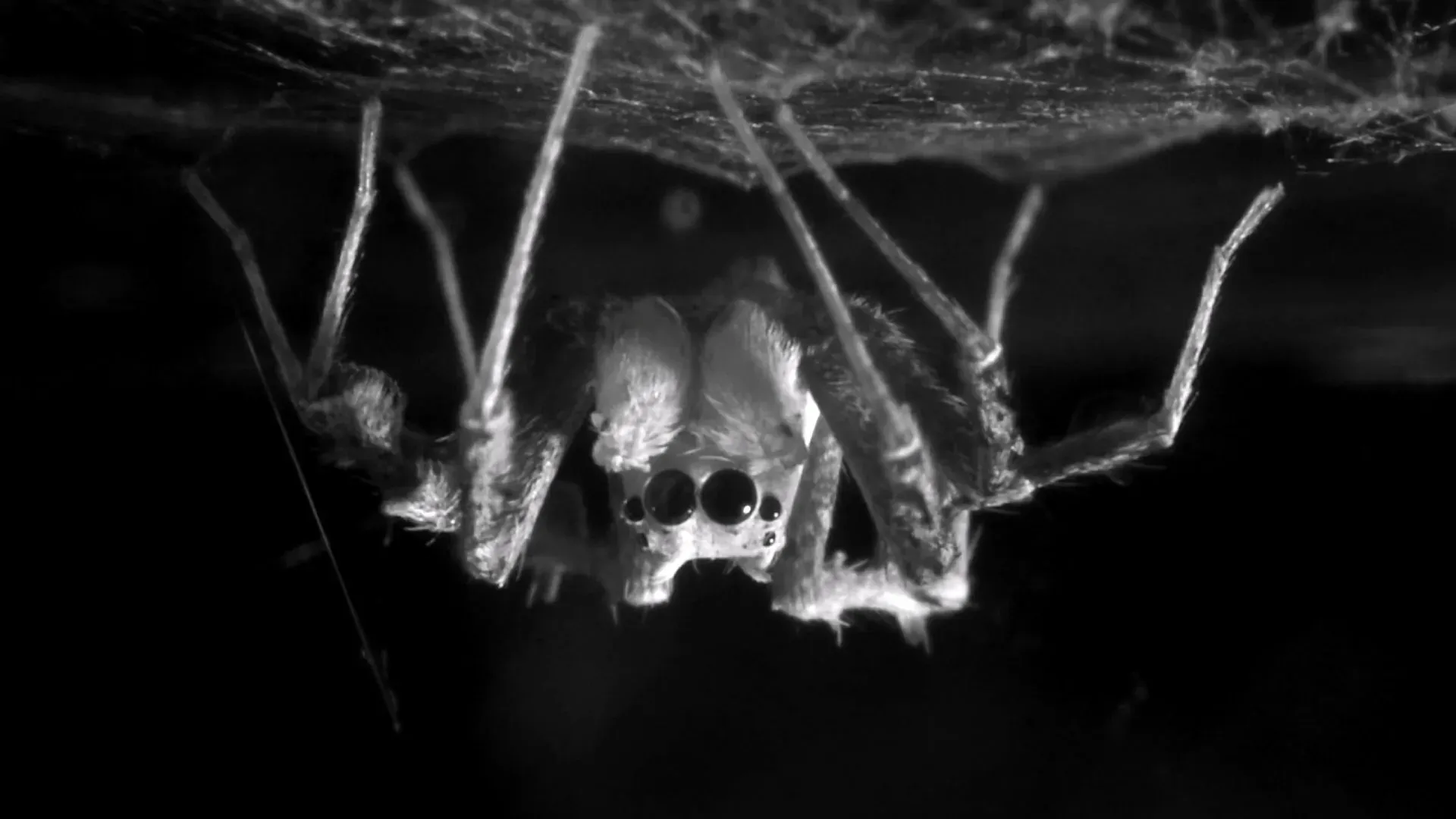
At night, the Australian jumping spider Portia fimbriata hangs upside down from a small silk thread and goes still. A team at the University of Bonn’s Institute of Organismic Biology in Germany filmed the spiders over several days and nights and concluded that they really do sleep, and in two stages.
In the first stage, the spider grooms itself and slowly lets its legs droop. In the second, it curls its legs, twitches and moves its eyes, much like REM sleep, the stage in which people usually dream. The study was published on 26 October in PNAS.
How do you know a spider is asleep?
Keeping still isn’t enough. To check that the spiders were sleeping, Daniela C. Rößler and Nadja Geiger’s team woke them with a sound and measured how long they took to react. In both stages they were slower to respond, or didn’t respond at all, and the delay was longest in the REM-like stage. Spiders deprived of sleep also slept more afterwards, just as we do.
Each spider lived in a 12-centimetre plastic dish, and at night infrared cameras recorded its postures and movements. The hardest part, the university says, was finding a stimulus the spiders reliably responded to. Thomas White of the University of Sydney, who was not involved, told ABC News it was “the most complete behavioural case for sleep in any arachnid”.
What we still don’t know
The researchers didn’t measure brain activity: everything rests on behaviour. And they point out that seeing REM-like movements doesn’t show that spiders dream.
Why it’s good news
Above all, it’s good news for knowledge. If an animal so different from us also sleeps in two stages, REM-like sleep may be far older and more widespread than thought: sleep, and perhaps something like dreaming, would be something we share with very distant animals.
It could also help protect them. Knowing how other animals sleep tells us what they need in order to rest. The team now wants to study other spider species, compare their sleep in the wild and in the lab, and look at how artificial light at night and climate change affect it.