Argentine scientists reseed Patagonian scallop beds, and the young scallops thrive
A CESIMAR (CONICET) team caught baby Tehuelche scallops on collectors and in 2025 sowed them on the seabed of San José Gulf, in Chubut, Argentina. A year and a half later they have grown like those in natural beds and are close to the 60-millimetre legal catch size. A new collector design quadrupled the number caught. It is still experimental: the next step is to test it with local shellfish divers.
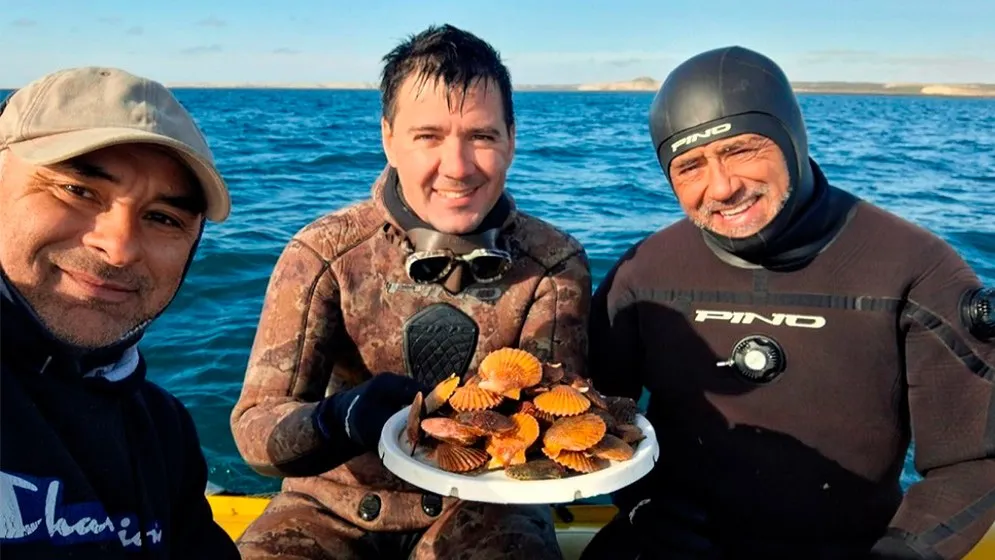
Two or three millimetres. That is the size of the scallops that settle on the nets a team of Argentine scientists hangs in the sea of San José Gulf, in northern Chubut. A year and a half after being sown on the seabed, the 2025 batch is close to 60 millimetres, the minimum size at which they can be caught.
The project is led by postdoctoral fellow Leandro Getino Mamet and researcher Gaspar Soria, of the Centre for the Study of Marine Systems (CESIMAR, part of Argentina’s national research council, CONICET). Chubut’s fisheries department, a student from the National University of Patagonia San Juan Bosco and CENPAT’s divers also take part. It is still an experimental trial, but the team says it shows that reseeding the beds is technically and biologically feasible.
A net the larvae “love”
The Tehuelche scallop (Aequipecten tehuelchus) is harvested by hand, by divers working down to 25 metres, and supports the gulf’s small-scale shellfishery. Its beds go through natural boom-and-bust cycles which, on top of fishing pressure, can take several seasons to recover.
The scallops spawn between late December and January, and their larvae swim for about a month looking for somewhere to settle. “In nature they settle on seaweed or shell fragments, but we give them a surface they love: Netlon mesh,” says Getino Mamet. The young scallops grow on the mesh for a few months and are then sown on the seabed.
Monitoring showed that they grew just like those in natural beds.
Fewer sea squirts, more scallops
The first year brought a problem: sea squirts colonise the collectors and make it hard to recover the young scallops. In 2026 the divers tried cleaning the collectors, with good results, and the team tested a different collector design with which the number of scallops caught quadrupled.
The next step is to put many more collectors in the sea, with support from the Williams Foundation, and to work side by side with local shellfish divers, using their boats and their knowledge of the gulf, to see whether the system works in real fishing conditions.