Spanish scientists build cancer-fighting immune cells with a switch to turn their attack up or down
Researchers at the Hospital del Mar Research Institute, Spain's National Cancer Research Centre (CNIO) and the i+12 institute of Madrid's 12 de Octubre Hospital have engineered T cells that make the two halves of a tumour-targeting antibody separately. The halves only join when a drug is given, and the dose sets how strong and how long the response is. So far it has only been tested in the lab and in mice: safety studies and patient trials are still needed.
The patient’s own cells make the weapon, but they don’t assemble it until they get the signal. That is the idea behind a study by a team from the Hospital del Mar Research Institute in Barcelona, the National Cancer Research Centre (CNIO) and the i+12 research institute of the 12 de Octubre Hospital in Madrid, published in the journal Advanced Science, which put it on the cover of its latest issue. It has been tested in the lab and in mice, not yet in people.
Two halves that need a drug to meet
Luis Álvarez-Vallina’s group designed STAb-T therapies some years ago: a patient’s T cells are modified to secrete bispecific antibodies, which grab the immune cell and the tumour cell at the same time. “In STAb-T immunotherapy, the modified T cells produce bispecific antibodies,” Álvarez-Vallina explains, according to Diariofarma.
What is new is that the T cells now make the antibody’s parts separately. They only come together when a drug is given. “The drug acts as a chemical switch,” says Susana Luengo-Arias, the paper’s first author. Without it, the contact point between the T cell and the tumour cell, known as the immunological synapse, does not form.
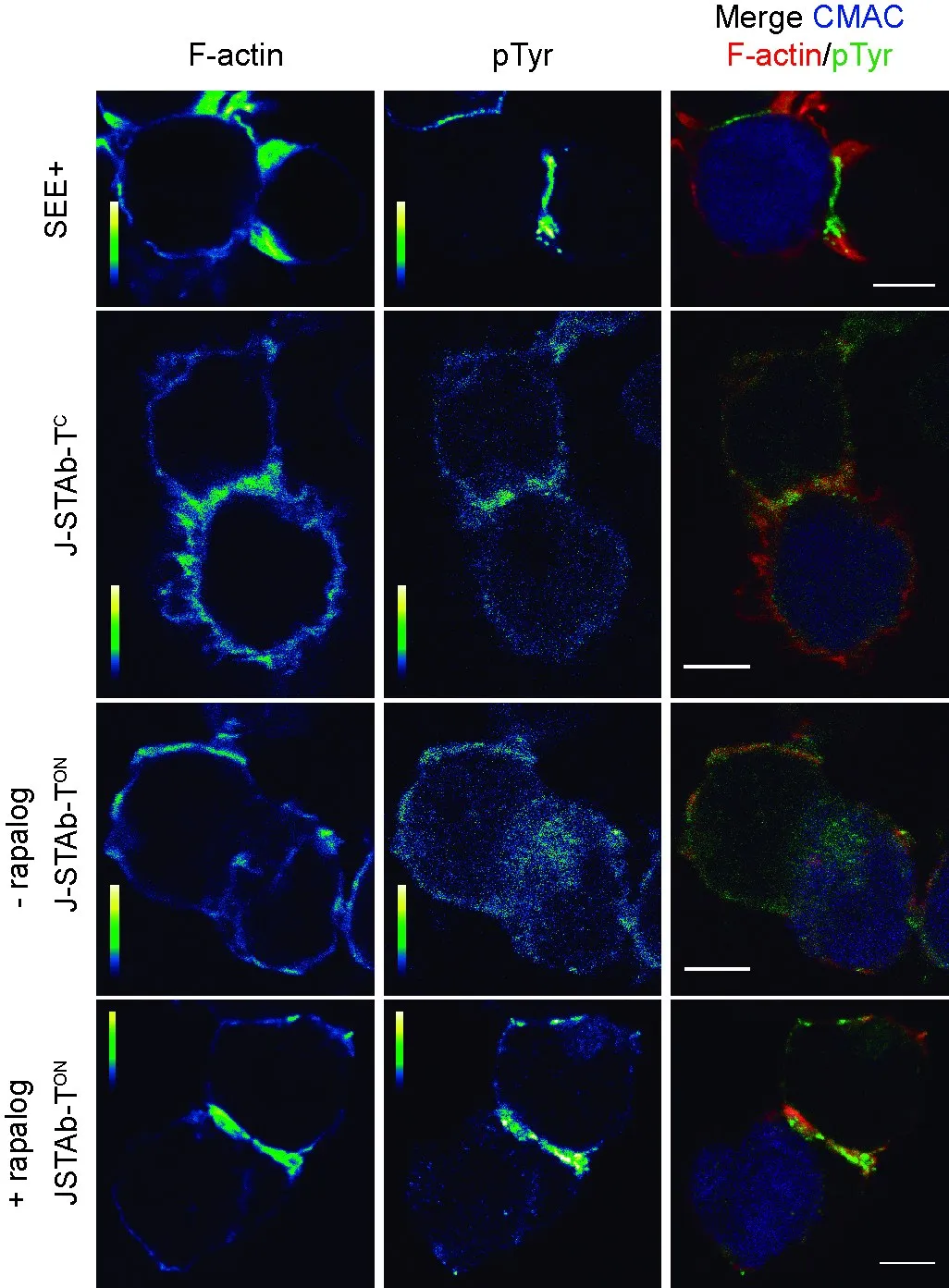
Formation of the drug-regulated immunological synapse, in microscope images from the study. Image: Hospital del Mar Research Institute.
On, off and dialled up or down
According to the team, the drug can switch the modified cells on or off and set how strong and how long the response is. The work, co-led by Álvarez-Vallina and Anaïs Jiménez-Reinoso, was tested against two targets: CD19, in blood cancers, and EGFR, in solid tumours.
That control matters most in solid tumours. Many of their targets are also found in healthy tissue, and an attack that cannot be stopped raises the risk of toxic side effects. Lowering the dose or withdrawing the drug would be a way to put the brakes on.
What it needs before reaching patients
The authors stress that this is a preclinical study. Before it can be used in people, its safety has to be confirmed in further studies and it must be tested in clinical trials. The STAb-T therapies it builds on are already in trials, according to Diariofarma; the switchable version is not.
Sources
- EFE via Cooperativa.cl · Terapia con “interruptor químico” abre vías menos tóxicas para tratar cánceres sólidos (4 Nov 2026, in Spanish)
- Diariofarma · Una terapia celular con ‘interruptor químico’ abre una vía a inmunoterapias menos tóxicas (4 Nov 2026, in Spanish)
- Hospital del Mar Research Institute · Press room